
Vol 6 (2020): post(s) 6

Issue Description

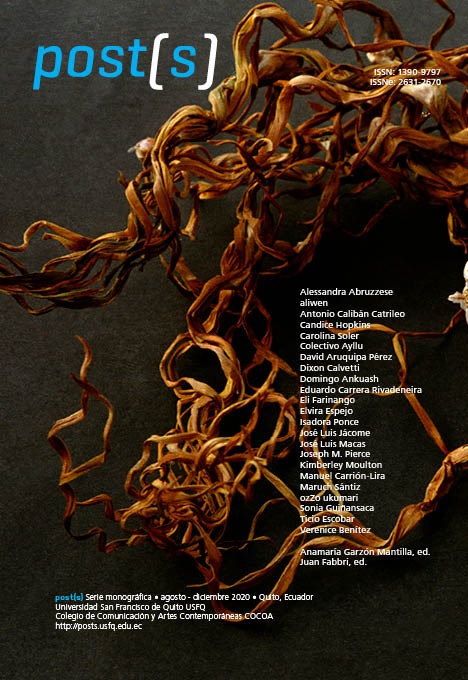
The call for papers for post(s) 6, written by Juan Fabbri, was a provocation to think about contemporary artistic practices and their relationship with indigenous, native, or rural communities. It proposed to think about the role that art plays in a scenario of changes and social struggles. Nevertheless, the articles featured in this issue go beyond that. The authors who responded to the call for papers changed the agenda. The essays submitted indeed speak of artistic and curatorial practices, but expanding these perspectives, they also address conflicts of race, gender dissidence, lives marked by migrations, bilingualism, practices of popular culture, and anti-extractivism. 
In this edition, Shuar, Mapuche, Aymara, Quechua, Tzotzil, Kichwa, Yorta-Yorta, Guaraní, Cherokee, Tlingit and mestizxs/campuria/criollxs and racialized authors gather together. They invite us to become familiar with their practices and their discourses, with the recognition of their pasts, and with their languages. Reading this issue, then, is also a provocation for the sight, hearing and understanding. Since these combinations deliberately seek to break with the normativity of language. The 20 essays that conform this issue open a possibility to think the future by looking at the roots.
##issue.tableOfContents##

Table of Contents

Introducción

Pluriversos indígenas y ejercicios de resistencia
Anamaría Garzón Mantilla, Juan Fabbri
DOI: https://doi.org/10.18272/post(s).v6i1.2120

Akademos

The desiring impasse: Translations, misunderstandings and racism in Chile
Joseph M.
DOI: https://doi.org/10.18272/post(s).v6i1.1884
Taiñ ngoymanuam / Not to forget: Why make visible an epupillan memory?
Antonio Caliban Catrileo
DOI: https://doi.org/10.18272/post(s).v6i1.1856
Catrileo+Carrión Community: epupillan artistic practice and political regeneration in Wallmapu
Manuel Antonio Carrión Lira
DOI: https://doi.org/10.18272/post(s).v6i1.1857
Mestizo Music: a topography of modes of listening.
Isadora Ponce Berrú
DOI: https://doi.org/10.18272/post(s).v6i1.1944

Radar

We Are Always Turning Around on Purpose: Reflecting on Three Decades of Indigenous Curatorial Practice
Candice Hopkins
DOI: https://doi.org/10.18272/post(s).v6i1.2096
I Can Still Hear Them Calling. Echoes of My Ancestors
Kimberley Moulton
DOI: https://doi.org/10.18272/post(s).v6i1.2095
Today more than ever it is necessary to open the door to other systems of cultures, knowledges and wisdoms
Ticio Escobar , Anamaría Garzón Mantilla, Juan Fabbri
163-168
DOI: https://doi.org/10.18272/post(s).v6i1.2113
Weaving between territories
Elvira Espejo , Juan Fabbri
DOI: https://doi.org/10.18272/post(s).v6i1.2107
Brown and Black Affectivities: Conversation with Colectivo Ayllu - Migrant Transgressors of the Kingdom of Spain
Colectivo Ayllu , Eduardo Carrera Rivadeneira
DOI: https://doi.org/10.18272/post(s).v6i1.2098

Videre

El arte de la medicina ancestral. Plantas medicinales, 2004 - 2015
Maruch Sántiz Gómez
DOI: https://doi.org/10.18272/post(s).v6i1.2086
Healing Through Remembering
Eli Farinango
DOI: https://doi.org/10.18272/post(s).v6i1.2072

Praxis

becoming campuria
aliwen aliwen
DOI: https://doi.org/10.18272/post(s).v6i1.2105
Etsa-Nantu/Cámara-Shuar, Film Laboratory from the Shuar Territory
Domingo Ankuash, Verenice Benitez, Carolina Soler
DOI: https://doi.org/10.18272/post(s).v6i1.2067
From the Spiritist Medium to the Artist Medium: The Cult of María Lionza as an Artistic Practice
Dixon Calvetti
DOI: https://doi.org/10.18272/post(s).v6i1.1842
Draw by erasing, clean by drawing
José Luis Macas Paredes
DOI: https://doi.org/10.18272/post(s).v6i1.1908
The transvestite aesthetic revolution in Bolivian popular festivals
David Aruquipa
DOI: https://doi.org/10.18272/post(s).v6i1.2097
Yangareko. Micro artistic residencies in El Chaco
ozZo ukumari
DOI: https://doi.org/10.18272/post(s).v6i1.2094
Transcreation, intertextuality and ethnopoetics
Alessandra Abruzzese
DOI: https://doi.org/10.18272/post(s).v6i1.1861
Andean Density, the Khipunk Universe
José Luis Jácome Guerrero
DOI: https://doi.org/10.18272/post(s).v6i1.1895
Poems
Sonia Guiñansaca
DOI: https://doi.org/10.18272/post(s).v6i1.2112
View All Issues