
Keywords
egagrópilas
Rattus
Cuenca.
How to Cite
Share
Downloads
Societal impact
Abstract
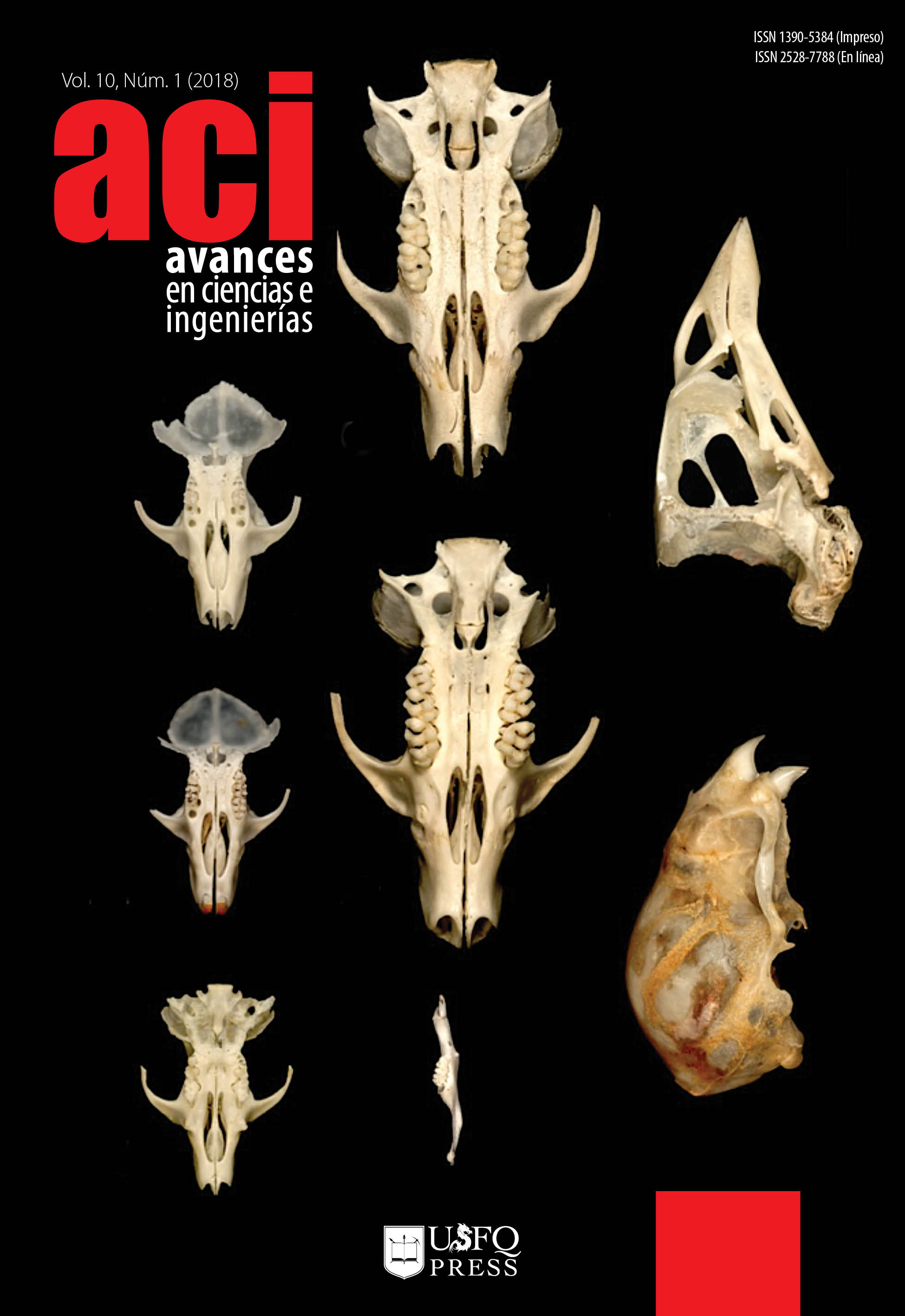
La progresiva expansión de las urbes no solo implica modificación de los ecosistemas, está también asociada a la introducción de especies plaga. En este sentido, es importante evaluar cómo especies nativas actúan como controladores de plagas. Para asegurar esto, se presenta un análisis de la dieta, basada en egagrópilas, de Tyto alba (Lechuza Campanaria) en la ciudad de Cuenca, Ecuador. En base a 32 egagrópilas, colectadas entre Abril y Junio de 2017, se registró un total de 154 presas asociadas a nueve identidades taxonómicas. Los roedores fueron las presas más abundantes con 129 registros (84%) como así también fueron los de mayor biomasa, 49 g (93%). Más importante, tanto la abundancia como biomasa del género Rattus (ratas) fueron significativamente mayores al comparar con el resto de presas. Es evidente, que T. alba cumple un rol como controlador de plagas en la ciudad de Cuenca. Estos hallazgos son similares a los reportados para T. alba en varias localidades a través del continente; en consecuencia, es una especie clave en el control de roedores con un efecto positivo sobre la salud de los ecosistemas urbanos.
References
Hooper, D. U., Adair, E. C., Cardinale, B. J., Byrnes, J. E. K., Hungate, B. A., Matulich, K. L. & O"™Connor, M. I. (2012). A global synthesis reveals biodiversity loss as a major driver of ecosystem change. Nature, 486(7401), 105. https://doi.org/10.1038/nature11118
Sala, O. E., Chapin Iii, F. S., Armesto, J. J., Berlow, E., Bloomfield, J., Dirzo, R. &Wall, D. H. (2000). Global Biodiversity Scenarios for the Year 2100. https://doi.org/10.1126/science.287.5459.1770
Sekercioglu, C. H. (2006). Increasing awareness of avian ecological function. Trends in Ecology and Evolution, 21(8), 464-471. https://doi.org/10.1016/j.tree.2006.05.007
Schüttler, E., & Santiago Karez, C. (2008). Especies exóticas invasoras en las Reservas de Biosfera de América Latina y el Caribe. (E. Schüttler & C. Santiago Karez, Eds.). Montevideo: UNESCO. Recuperado de http://unesdoc.unesco.org/images/0018/001827/182768s.pdf
Abramsky, Z., Rosenzweig, M. L., & Subach, A. (2002). The costs of apprehensive foraging. Ecology, 83(5), 1330-1340. https://doi.org/10.1890/0012-9658(2002)083[1330:TCOAF]2.0.CO;2
Brown, J. S., Kotler, B. P., Smith, R. J., Ii, W. O. W., Brown, J. S., Kotier, B. P. & Ii, W. O. W. (1988). The Effects of Owl Predation on the Foraging Behavior of Heteromyid Rodents The effects of owl predation on the foraging behavior of heteromyid rodents. Oecologia, 76(3), 408-415.
Carevic, F. S. (2011). Rol del pequén (Athene cunicularia ) como controlador biológico mediante el análisis de sus hábitos alimentarios en la Provincia de Iquique, norte de Chile. Idesia (Arica), 29(1), 15-21. https://doi.org/10.4067/S0718-34292011000100003
Hegdal, P. L., & Blaskiewicz, R. W. (1984). Evaluation of the potential hazard to barn owls of talon (brodifacoum bait) used to control rats and house mice. Environmental Toxicology and Chemistry, 3(1), 167-179. https://doi.org/10.1002/etc.5620030119
Kay, B., Twigg, L., Korn, T., & Nicol, H. (1994). The use of artifical perches to increase predation on house mice (mus domesticus) by raptors. Wildlife Research, 21(1), 95. https://doi.org/10.1071/WR9940095
Quintero-Romanillo, A. L., Barreras-Fitch, R. C., Orozco-Gerardo, J. A. & Rangel-Cota, G. (2009). Determination of birds of prey species in the supplying area of Sugarcane (Sacharum officinarum) of the sugar company of LOS MOCHIS S. A. OF C. V., which can be used in integrated pest managment as biological control. Ra Ximhai, 5(2), 239-245. Recuperado de http://www.redalyc.org/pdf/461/46111507009.pdf
Rau, J. (2014). Papel ecológico de las aves rapaces: del mito a su conocimiento y conservaciónen Chile (Nelson Col). Osorno: Departamento de Ciencias Biológicas y Biodiversidad, Universidad de Los Lagos, Campus Osorno, Chile. Recuperado de https://www.researchgate.net/profile/Jaime_Rau/publication/273449091_Papel_Ecologico_de_las_Aves_Rapaces_del_Mito_a_su_Conocimiento_y_Conservacion_en_Chile/links/5501d9620cf2d60c0e620e1a.pdf
Vanacker, V., Govers, G., Barros, S., Poesen, J. & Deckers, J. (2003). The effect of short-term socio-economic and demographic change on landuse dynamics and its corresponding geomorphic response with relation to water erosion in a tropical mountainous catchment, Ecuador. Landscape Ecology, 18, 1-15. Recuperado de https://link.springer.com/article/10.1023/A:1022902914221
Astudillo, P. X. & Siddons, D. C. (2013). Avifauna de Santa Ana de los Cuatro Rios de Cuenca, Ecuador. Cuenca: Comisión de Gestión Ambiental de Cuenca, Municipalidad de Cuenca, Universidad del Azuay.
FjeldsaÌŠ, J., & Krabbe, N. (1990). Birds of the high Andes. Zoological Museum, University of Copenhagen.
Bellocq, M. (2000). A review of the trophic ecology of the Barn Owl in Argentina. Journal of Raptor Research (Vol. 34).
Bó, M. S., Baladrón, A. V., & Biondi, L. M. (2007). Ecología Trófica De Falconiformes Y Strigiformes Tiempos de Síntesis. Hornero, 22(2), 97-115. Recuperado de http://www.scielo.org.ar/scielo.php?pid=S0073-34072007000200003&script=sci_pdf
Mikkola, H. (1995). Rapaces nocturnas de Europa. Perfils.
Proudfoot, G. (2011). Owls of the World, 2nd ed. Bio One, 128(1)(1), 187-189. Recuperado de http://www.bioone.org/doi/pdf/10.1525/auk.2011.128.1.187
Thiollay, J.-M. (2001). Long-term changes of raptor populations in Northern Cameroon. J. Raptor Res, 353(35), 173-18. Recuperado de https://sora.unm.edu/sites/default/files/journals/jrr/v035n03/p00173-p00186.pdf
Venable, N. J. (1996). Birds of Prey. West Virginia University Extension Service. West Virginia. Recuperado de http://swordshouse.galeon.com/pdf/birds_of prey_norma_jean_venable.pdf
Brito, J., Orellana-Vásquez, H., Cadena-Ortiz, H., Vargas, R., Pozo-Zamora, G., & Curay, J. (2015). Mamiferos pequeños en la dieta de la lechuza Tyto alba (Strigiformes: Tytonidae) en dos localidades del occidente de Ecuador, con ampliacion distribucional de Ichthyomys hydrobates (Rodentia: Cricetidae). Scielo, 55(19), 261-268.
Charpentier, A., & Martínez, J. (2007). Abundancia y Dieta de Tyto alba, la lechuza de campanario, en la ciudad de Cuenca.
Moreno, P. A. (2010). Mamíferos presentes en la dieta de la Lechuza de Campanario (Tyto alba) en Valdivia, provincia de Guayas, Ecuador. Avances En Ciencias E Ingenierias. Recuperado de http://www.usfq.edu.ec/publicaciones/avances/archivo_de_contenidos/Documents/volumen_2_numero_3/Avances_2010_vol2_B87-B90.pdf
Rocha, R. G., Ferreira, E., Leite, Y. L. R., Fonseca, C., & Costa, L. P. (2011). Small mammals in the diet of barn owls, Tyto alba (Aves: Strigiformes) along the mid-Araguaia river in central Brazil. Zoologia (Curitiba), 28(6), 709-716. https://doi.org/10.1590/S1984-46702011000600003
Fernández de Córdova-Torres, J. & Nivelo, C. (2016). Guía de mamíferos de las zonas urbana y periurbana de Cuenca. GOBIERNO AUTONOMO DECENTRALIZADO MUNICIPAL DEL CANTÓN CUENCA, COMISIÓN DE GESTIÓN AMBIENTAL, UNIVERSIDAD DEL AZUAY, Cuenca-Ecuador.
Delgado, C. A. &, & Cataño, E. (2004). Diet of The Barn Owl (Tyto alba) in the Lowlands of Antioquia, Colombia. Ornitologia Neotropical, 15, 413-415. Recuperado de https://www.researchgate.net/profile/Carlos_A_Delgado_V/publication/260592283_Diet_of_the_barn_owl_Tyto_alba_in_the_lowlands_of_Antioquia_Colombia/links/0c960531a42444f8ec000000/Diet-of-the-barn-owl-Tyto-alba-in-the-lowlands-of-Antioquia-Colombia.pdf
Fuentes, L., Sequera, I., Poleo, C., & Díaz, L. (2015). Composición de la dieta de Tyto alba Scopoli en hábitats de Calabozo, Venezuela. Investigación Agraria, 17(1), 46-53. https://doi.org/10.18004/investig.agrar.2015.junio.46-53
Figueroa R., R. A., Rau, J. R., Mayorga, S., Martínez, D. R., Corales S., E. S., Mansilla, A., & Figueroa M., R. (2009). Rodent Prey of the Barn Owl Tyto alba and Short-Eared Owl Asio flammeus During Winter in Agricultural Lands in Southern Chile. Wildlife Biology, 15(2), 129-136. https://doi.org/10.2981/08-005
Freile, J., Guevara, E. A., Pacheco, C., & Santander, T. (2015). Los Búhos de Ecuador. (P. Enríquez, Ed.), Los Búhos Neotropicales: Diversidad y Conservación. Quito. Recuperado de https://www.researchgate.net/publication/283505955_Los_Buhos_de_Ecuador
Marti, C. D., Steenhof, K., Kochert, M. N., & Marks, J. S. (1993). Community Trophic Structure: The Roles of Diet, Body Size, and Activity Time in Vertebrate Predators. Oikos, 67(1), 6. https://doi.org/10.2307/3545090
Bonvicino, C. R., & Bezerra, A. M. R. (2003). Use of Regurgitated Pellets of Barn Owl (Tyto alba) for Inventorying Small Mammals in the Cerrado of Central Brazil. Studies on Neotropical Fauna and Environment, 38(1), 1-5. https://doi.org/10.1076/snfe.38.1.1.14030
Guimaraes, S., Fernandez-Jalvo, Y., Stoetzel, E., Gorgé, O., Bennett, E. A., Denys, C., "¦ Geigl, E. M. (2016). Owl pellets: A wise DNA source for small mammal genetics. Journal of Zoology, 298(1), 64-74. https://doi.org/10.1111/jzo.12285
Glue, D. E. (1967). Prey taken by the Barn Owl in England and Wales. Bird Study, 14(3), 169-183. https://doi.org/10.1080/00063656709476160
INAMI. (2008). Instituto Nacional de Metereología e Hidrología. Obtenido de Instituto Nacional de Metereología e Hidrología: http://www.serviciometeorologico.gob.ec/
Herrera, C. (1974). Regimen alimenticio de Tyto alba en España sudoccidental. Ardeola, 19, 36. Recuperado de http://www.ardeola.org/files/1023.pdf
Carleton, M. D., & Musser, G. G. (1989). Systematic studies of oryzomyine rodents (Muridae, Sigmodontinae) : a synopsis of Microryzomys. Bulletin of the AMNH ; no. 191, 191, 1-83. Recuperado de http://digitallibrary.amnh.org/handle/2246/953
Gaunt, W. A. (1995). The Development of the molar pattern of the mouse (Mus musculus). Zoology Department, Victoria University, Manchester, 24, 20.
Patton, J. L., Pardiñas, U. F. J., & D"™EliÌa, G. (2015). Mammals of South America. Volume 2, Rodents.
Tirira, D. G. (2007). Mamíferos del Ecuador. Recuperado de http://www.mamiferosdelecuador.com/diversidad-menu/diversidad/item/55-molossidae/167-nyctinomops-macrotis-gray,-1840.html
Weksler, M., & Percequillo, A. R. (2011). Key to the genera of the Tribe Oryzomyini (Rodentia: Cricetidae: Sigmodontinae). Mastozoología Neotropical, 18(2), 281-292. https://doi.org/10.1206/0003-0082(2006)3537[1:TNGOOR]2.0.CO;2
Plug, C., & Plug, I. (1990). MNI Counts as Estimates of Species Abundance. The South African Archaeological Bulletin, 45(151), 53. https://doi.org/10.2307/3887918
Manning, R. W. & Jones, J. K. (1990). Remains of small mammals recovered from Barn Owl pellets from Crosby county, Texas. Texas Journal o Sience, 42(3), 311-312. Recuperado de http://www.scielo.br/scielo.php?script=sci_nlinks&pid=S0031-1049201500190026100019&lng=en
Herrera, C. & Jaksié, F. (1980). Feeding Ecology of the Barn Owl in Central Chile and Southern Spain: A Comparative Study. The Auk, 97(4), 760-767. Recuperado de http://www.jstor.org/stable/4085747
Zar, J. H. (1984). Biostatistical analysis. Prentice-Hall. Recuperado de https://openlibrary.org/books/OL3171690M/Biostatistical_analysis
R Development Core Team. (2011). R: a language and environment for statistical computing. Recuperado de https://www.gbif.org/tool/81287/r-a-language-and-environment-for-statistical-computing
Núñez, S., & Cisterna, L. (1991). Roedores domésticos I. Caracterización morfológica conductual y sanitaria. Monografías de Medicina Veterinaria, 13 (1). Recuperado de https://web.uchile.cl/vignette/monografiasveterinaria/monografiasveterinaria.uchile.cl/CDA/mon_vet_completa/0,1421,SCID%253D18032%2526ISID%253D433,00.html
Lobos, G., Ferres, M. &, & Palma, R. (2005). Presencia de los géneros invasores Mus y Rattus en áreas naturales de Chile: un riesgo ambiental y epidemiológico. Revista Chilena de Historia Natural, 78, 113-124. Recuperado de http://www.redalyc.org/pdf/3699/369944273008.pdf
Figueroa, R. A., Soraya, R., Stappung, C., Cerda, J., Hernaldo, C., & Pérez, S. (2001). Roedores, Rapaces y Carnívoros en Aysen. Servicio Agrícola y Ganadero. Recuperado de http://www.sag.cl/sites/default/files/roedores_rapaces_aysen.pdf
Buj, A. (1999). Los riesgos epidémicos actuales desde una perspectiva geográfica. Revista Electronica de Geografia Y Ciencias Sociales, 39. Recuperado de http://www.ub.edu/geocrit/sn-39.htm
Tamayo Uría, I., Cámara, J. . &, & Escobar, F. . (2013). Identificación y cartografiado de factores de riesgo en la proliferación de rata de alcantarilla (Rattus norvegicus) en medio urbano. Revista de Salud Ambiental, 13(2), 148-157. Recuperado de http://www.ojs.diffundit.com/index.php/rsa/article/view/389
Hernández-Muñoz, A., & Mancina, C. A. (2011). La dieta de la lechuza (Tyto alba) (Aves: Strigiformes) en hábitats naturales y antropogénicos de la región central de Cuba. Revista Mexicana de Biodiversidad, 82(1), 217-226. Recuperado de http://www.scielo.org.mx/scielo.php?script=sci_arttext&pid=S1870-34532011000100019
Gutiérrez, G. (1998). Estrategias de forrajeo. En R. Ardila, W. López, A.M. Pérez, R. Quiñones, & F. Reyes (Eds.). Manual de Análisis Experimental del Comportamiento. Pgs. 359-381. Madrid: Librería Nueva.
Copyright notice
Authors who publish in ACI Avances en Ciencias e Ingenierías agree to the following terms and conditions:
1. Copyright and Publication License
Authors retain the copyright to their works and grant the journal the right of first publication. Articles are published under the Creative Commons Attribution-NonCommercial 4.0 International License (CC BY-NC 4.0), which allows third parties to copy, distribute, share, and adapt the content for non-commercial purposes, provided that appropriate credit is given to the authors, the original publication in the journal is acknowledged, a link to the license is included, and any modifications made are indicated.
2. Non-Exclusive Distribution Agreements.
Authors may enter into additional non-exclusive distribution agreements for the published version of their work, including its inclusion in books, edited volumes, institutional repositories, or other academic platforms, provided that the original publication in ACI Avances en Ciencias e Ingenierías is acknowledged and the corresponding bibliographic reference is included.
3. Dissemination and Self-Archiving.
The journal permits and encourages authors to disseminate their work through academic and institutional repositories and other digital platforms to increase its visibility, accessibility, and scientific impact.
a. Before publication: Authors may deposit their manuscripts in preprint servers or repositories before submitting them to the journal. They may also share their research through ACI Preprints.
b. After publication: Authors may share and deposit the final published version of their articles (Version of Record, VoR) in institutional and academic repositories (such as Zenodo), personal websites, and academic networking platforms (such as ResearchGate and Academia.edu), in accordance with the terms of the CC BY-NC 4.0 license. Authors are encouraged to include the complete bibliographic reference, DOI, and link to the original publication in the journal.