
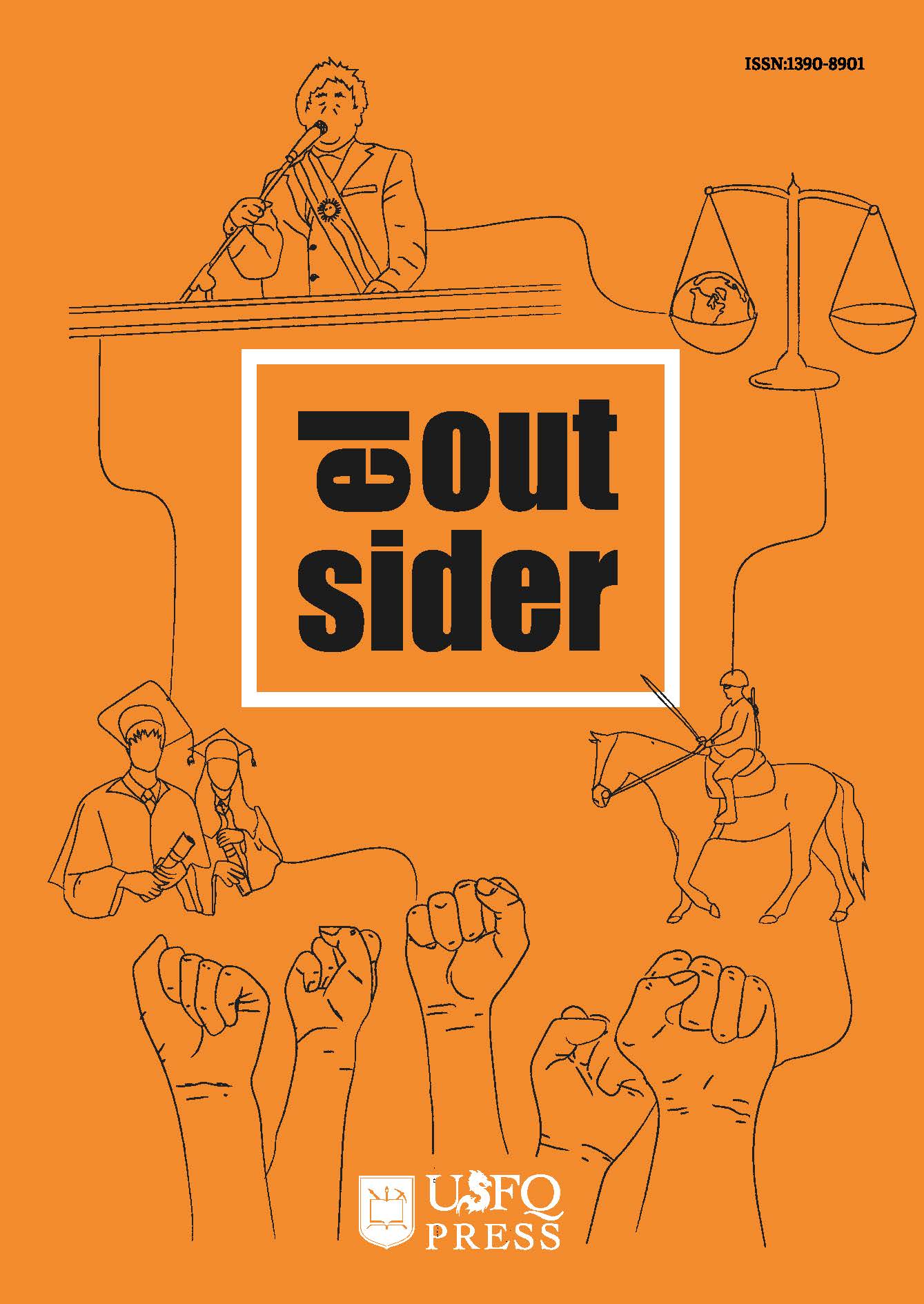
Forg(c)ing Israel. The use of rhetoric to create and maintain the State
Article Sidebar
Main Article Content
Abstract
The present article analyzes the evolution of the State of Israel through the rhetoric used to justify and maintain itself in the international system, despite criticisms of internal governance and the conflict with Palestine. Through the analysis of formative events for politics and government, the discourses used, their how and why, as well as the effects they have had on the population, are reviewed. Likewise, the current war in Gaza is addressed to understand the discursive management with transversality to themes inherent to the Jewish experience before and after Israel. Topics explored include the Holocaust, militarization, race and ethnicity, religion, and national identity.
Downloads
Article Details
Section

This work is licensed under a Creative Commons Attribution-NonCommercial 4.0 International License.
The authors, by publishing in this journal, accept the following terms:
- The authors will retain their copyrights and will guarantee the journal the right of first publication of their work, which will be simultaneously subject to the Creative Commons Acknowledgement License that allows third parties to share the work as long as its author and its first publication in this journal are indicated.
- Authors may adopt other non-exclusive license agreements for the distribution of the published version of the work, thus being able to publish it in a monographic volume or reproduce it in other ways, provided that the initial publication in this journal is indicated.
- Authors are allowed and encouraged to disseminate their work via the Internet:
- Before journal submission, authors can deposit the manuscript in preprint servers/repositories, including arXiv, bioRxiv, figshare, PeerJ Preprints, and SSRN, among others, which can produce interesting exchanges and increase citations of the published work (See The effect of open access).
- After submission, it is recommended that authors deposit their article in their institutional repository, personal web page, or scientific social network (such as Zenodo, ResearchGate o Academia.edu).
How to Cite
References
Abu-Lughod, Ibrahim A. 1985. “Palestinian Culture and Israel’s Policy”. Arab Studies Quarterly (no. 2/3): 95–103. http://www.jstor.org/stable/41857772.
Ansary, Tamim. 2009. Destiny Disrupted: a history of the world through Islamic eyes. New York: Public Affairs.
Ariely, Gal. 2019. “National Days, National Identity, and Collective Memory: Exploring the Impact of Holocaust Day in Israel”. Political Psychology (6): 1391–1406. http://www.jstor.org/stable/45223198.
Ben-Eliezer, Uri. 1995.“A Nation-In-Arms: State, Nation, and Militarism in Israel’s First Years”. Comparative Studies in Society and History (2): 264–85. http://www.jstor.org/stable/179282.
Brown, Kenneth. 1983. “Iron and a King: The Likud and Oriental Jews”. MERIP Reports (114): 3–13. https://doi.org/10.2307/3010917.
Canetti, Daphna, Gilad Hirschberger, Carmit Rapaport, Julia Elad-Strenger, Tsachi Ein-Dor, Shifra Rosenzveig, Tom Pyszczynski, and Stevan E. Hobfoll. 2018. “Collective Trauma From the Lab to the Real World: The Effects of the Holocaust on Contemporary Israeli Political Cognitions”. Political Psychology (1): 3–21. http://www.jstor.org/stable/45094414.
Divine, Donna Robinson. 2014. “Zionism and the Politics of Authenticity”. Israel Studies (2): 94–110. https://doi.org/10.2979/israelstudies.19.2.94.
Don-Yehiya, Eliezer. 2014. “Messianism and Politics: The Ideological Transformation of Religious Zionism”. Israel Studies (2): 239–63. https://doi.org/10.2979/israelstudies.19.2.239.
El País. 2024. “DIRECTO GAZA | Audiencia en La Haya por la denuncia de Sudáfrica a Israel. | EL PAÍS”. En directo, El País, enero 11, 2024. Video, 3:03:57. https://www.youtube.com/watch?v=9Tc7MzeWpnc.
Falk, Richard. 1983. “Israel and Jewish identity”. Dialectical Anthropology (1/2): 87–111. http://www.jstor.org/stable/29790093.
Gertz, Nurith. 2020.“Who Is a Jew?: Dan Ben Amotz’s Novel To Remember, To Forget”. In History and Literature: New Readings of Jewish Texts in Honor of Arnold J. Band, edited by William Cutter and David C. Jacobson. Brown Judaic Studies (2): 357-367. https://doi.org/10.2307/j.ctvzpv540.36
Glass, Charles. 1975. “Jews against Zion: Israeli Jewish Anti-Zionism”. Journal of Palestine Studies (1/2): 56–81. https://doi.org/10.2307/2535683.
Gutwein, Daniel. 2009.“The Privatization of the Holocaust: Memory, Historiography, and Politics”. Israel Studies (1): 36–64. JSTOR, http://www.jstor.org/stable/30245843. Accessed 10 Dec. 2023.
Lapierre, Dominique, and Collins, Larry. 2011. Oh, Jerusalén. Tradución de Juan Moreno. Octava. Barcelona: Planeta. (Orig. pub. 2006.).
Lentin, Ronit. 2016.“Palestine/Israel and State Criminality: Exception, Settler Colonialism and Racialization”. State Crime Journal, vol. 5, No. 1 (1): 32–50. https://doi.org/10.13169/statecrime.5.1.0032.
Lustick, Ian S. 2017. “The Holocaust in Israeli Political Culture: Four Constructions and Their Consequences: Editor’s Note: This Article Is Followed by Four Comments and a Response by Ian Lustick”. Contemporary Jewry (1): 125–70. http://www.jstor.org/stable/26346572.
Massad, Joseph. 1996. “Zionism’s Internal Others: Israel and the Oriental Jews”. Journal of Palestine Studies (4): 53–68. https://doi.org/10.2307/2538006.
Ofer, Dalia. 2013.“We Israelis Remember, But How? The Memory of the Holocaust and the Israeli Experience”. Israel Studies (2): 70–85. JSTOR, https://doi.org/10.2979/israelstudies.18.2.70. Accessed 10 Dec. 2023.
Schoenmann, Ralph. 1988. Historia Secreta del Sionismo. Barcelona, Marxismo y Acción.
Sergides, Marina. 2012. “Housing in East Jerusalem: Marina Sergides Reports on an Legal Mission to the Occupied Palestinian Territory”. Socialist Lawyer (60): 14–17. JSTOR, https://doi.org/10.13169/socialistlawyer.60.0014. Accessed 10 Sept. 2023.
Shapira, Anita. 2004. “The Bible and Israeli Identity”. AJS Review (2): 11–41. http://www.jstor.org/stable/4131508.
Weinberg, Lee. 2016. “DIY: How to (Not So) Safely Dismantle the Bomb of On-Screen Jewish-Israeli Identity: The Synergies with Art and Television in the Representation of Jewish-Israeli Identity and What Can Be Learned from Them”. Jewish Film & New Media (1): 109–38. https://doi.org/10.13110/jewifilmnewmedi.4.1.0109
Weissbrod, Lilly. “Religion as National Identity in a Secular Society”. Review of Religious Research (3): 188–205. https://doi.org/10.2307/3511814.
Wistrich, Robert S. 1997. “Israel and the Holocaust Trauma”. Jewish History (2): 13–20. JSTOR, http://www.jstor.org/stable/20101298. Accessed 10 Dec. 2023.