
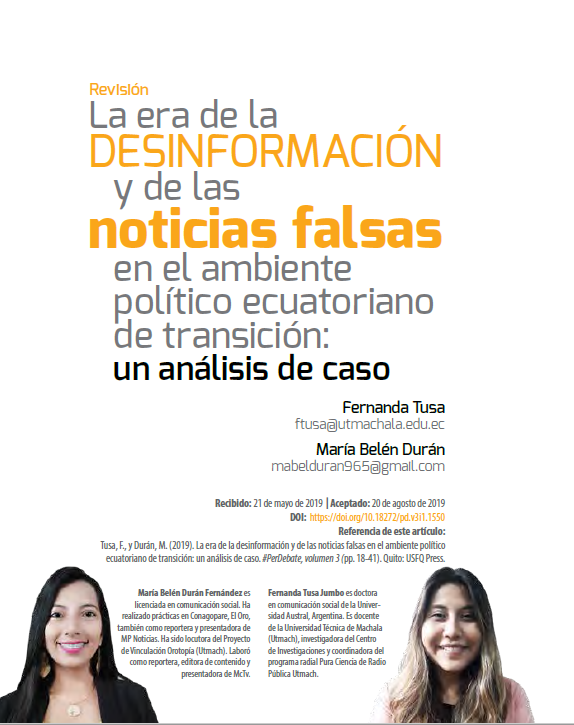
The era of misinformation and fake news in the ecuadorian political transition environment A case analysis
Article Sidebar
Main Article Content
Abstract
This article analyzes the problem of misinformation and false news in the Ecuadorian political context of transition, the change of president in the 2018-2019 period. To this end, a case analysis is structured focusing on the follow-up of the content of a militant of the Alianza Pais (AP) political movement and the monitoring of his Facebook account in the month of November-December 2018. The methodology applied, of a qualitative nature, uses techniques such as content analysis and virtual ethnography. The results show the type of false news used by this user-object of study and the recurrent themes in its digital activism. As a conclusion, it is considered that the phenomenon of false news is consciously produced by political activists in social networks, whose activism is based on the absolute defense of a particular dogma. Finally, it is recommended that the academy should include media literacy programs that promote the recognition of false news and forms of denunciation from civil society.
Downloads
Article Details
Issue
Section
Authors who publish in the journal agree to the following terms:
- Authors will retain their copyright and grant the journal the right of first publication of their work. The work will simultaneously be subject to the Creative Commons Attribution License, which allows third parties to share the work provided that its authorship is acknowledged and that its first publication in this journal is cited.
- Authors may enter into additional non-exclusive licensing agreements for the distribution of the published version of the work. This allows them to publish it in a monographic volume or reproduce it in other forms, provided that the initial publication in this journal is acknowledged.
- Authors are permitted and encouraged to disseminate their work through the Internet:
- Before submission to the journal, authors may deposit the manuscript in preprint archives or repositories (preprint servers/repositories), including arXiv, bioRxiv, figshare, PeerJ Preprints, SSRN, among others. This may foster valuable academic exchanges and increase citations of the published work (see The Open Access Effect).
- After submission, authors are encouraged to deposit their article in their institutional repository, personal website, or scientific social networks (such as Zenodo, ResearchGate, or Academia.edu).