
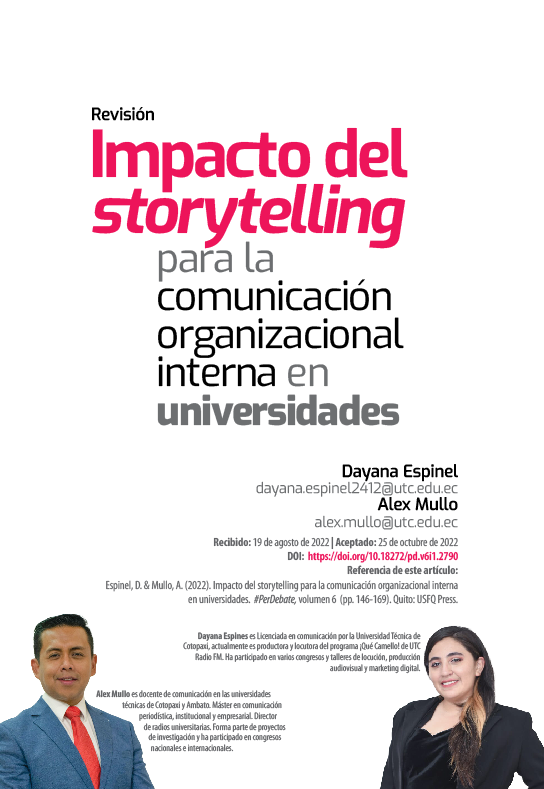
The impact of storytelling for internal communication in universities
Article Sidebar
Main Article Content
Abstract
The exposure of organizations on the web 2.0 has resulted in the public or customers being subjected to information over-saturation, which has determined that the entities generate new strategies to capture attention and form a direct relationship with the prosumer. This research uses qualitative and quantitative methodologies to evaluate how the storytelling strategy can influence the sense of belonging of the public to an institution. It is concluded that the strategy allows empowerment with the institution, thus making them speak positively of the organization since the stories appeal to the emotions of the recipients; the narrative, in addition to having an impact, makes the public accept changes in their daily lives.
Downloads
Article Details
Section

This work is licensed under a Creative Commons Attribution-NonCommercial 4.0 International License.
Authors who publish in the journal agree to the following terms:
- Authors will retain their copyright and grant the journal the right of first publication of their work. The work will simultaneously be subject to the Creative Commons Attribution License, which allows third parties to share the work provided that its authorship is acknowledged and that its first publication in this journal is cited.
- Authors may enter into additional non-exclusive licensing agreements for the distribution of the published version of the work. This allows them to publish it in a monographic volume or reproduce it in other forms, provided that the initial publication in this journal is acknowledged.
- Authors are permitted and encouraged to disseminate their work through the Internet:
- Before submission to the journal, authors may deposit the manuscript in preprint archives or repositories (preprint servers/repositories), including arXiv, bioRxiv, figshare, PeerJ Preprints, SSRN, among others. This may foster valuable academic exchanges and increase citations of the published work (see The Open Access Effect).
- After submission, authors are encouraged to deposit their article in their institutional repository, personal website, or scientific social networks (such as Zenodo, ResearchGate, or Academia.edu).
How to Cite
References
Alvino, C. (2022, 29 agosto). Estadísticas de la situación digital de Ecuador en el 2020-2021. Branch Agencia. https://branch.com.co/marketing+digital/estadisticas-de-la-situacion-digital-de-ecuador-en-el-2020-2021/
Asociación de Empresas Consultoras en Relaciones Públicas y Comunicación (Adecec). (s.f.). Guía storytelling y branded content. https://bit.ly/3gWbfe6
Apolo, D., Báez, V., Pauker, L. y Pasquel, G. (2017). Gestión de comunicación corporativa: consideraciones para el abordaje de su estudio y práctica. Revista Latina de Comunicación Social, (72), 521-539. https://bit.ly/3DyZcLi
Capriotti, P. (1999). Comunicación corporativa: Una estrategia de éxito a corto plazo. Reporte C&D: Capacitación y Desarrollo, (13), 30-33. https://bit.ly/3NswccH
Casado, L. (2008). Las historias que se cuentan en las empresas. Acción Psicológica, 5, 53-65.
Casas Moreno, P., Tejedor-Calvo, S. y Romero-Rodríguez, L. M. (2018). Micro-narratives on Instagram: analysis of the autobiographical storytelling and the projection of identities of the degrees in the field of communication. Prisma Social, (20), 40-57. https://bit.ly/3hd1Wqp
Castro Martínez, A. y Díaz Morilla, P. (2019). El proceso de enseñanza-aprendizaje de la Historia del Cine a través de una estrategia de storytelling y storydoing teatral aplicada al ámbito universitario. Icono14, 17(2), 154-181. https://doi.org/10.7195/ri14.v17i2.1378
García Alvarado, T. G. (2018). Comunicación organizacional 2.0: La comunicación siglo XX y la llegada del siglo XXI, el desafío de las empresas en la era digital.
Hamui Sutton, A. y Varela-Ruiz, M. (2013). La técnica de grupos focales. Investigación en Educación Médica, 2(5), 55-60. https://bit.ly/3Nvx28J
López-Hermida-Russo, A. y Vargas-Monardes, J. (2013). La política relatada: el Storytelling de Barack Obama en el marco de la Operación Gerónimo. Palabra Clave, 16(1), 12-44. https://bit.ly/3fATBw7
López-Roldán, P. y Fachelli, S. (2015). Metodología de la investigación social cuantitativa. Universitat Autònoma de Barcelona. https://bit.ly/3UltVSX
Guerrero-Pico, M. y Scolari, C. A. (2016). Narrativas transmedia y contenidos generados por los usuarios: El caso de los crossovers. Cuadernos.Info, 38, 183–200. https://doi.org/10.7764/cdi.38.760
Nuñez, A. (2009). El auge del storytelling o arte de narrar. www.seramejorquelocuentes.com
Oyarvide-Ramírez, H. P., Reyes Sarria, E. F. y Montaño-Colorado, M. R. (2017). La comunicación interna como herramienta indispensable. Dominio de las Ciencias, 3(4), 296-309. https://bit.ly/3UsM2GJ
Pérez-Vallejo, L. M., Vilariño-Corella, C. M. y Ronda-Pupo, G. A. (2016). El cambio organizacional como herramienta para coadyuvar con la implementación de la estrategia. Ingeniería Industrial, 37(3), 286-294. https://bit.ly/3NDYQYE
Pineda Henao, A. E. (2020). La comunicación organizacional en la gestión empresarial: retos y oportunidades en el escenario digital. Revista GEON: Gestión, Organizaciones y Negocios, 7(1), 9–25. https://doi.org/10.22579/23463910.182
Pineda-Martínez, P., y Ruiz-Mora, I. (2019). Internal communication and transmedia narratives, new strategies for responsible companies. Telefónica case study. Profesional de La Informacion, 28(5). https://doi.org/10.3145/epi.2019.sep.24
Pronaca. (2018, 23 de abril). Pronaca 2018 [Video]. Youtube. https://n9.cl/1ns6x
Pulido Polo, M. (2012). Técnicas de relaciones públicas en la comunicación organizacional. Revista Internacional de Relaciones Públicas, 2(3), 153-174. https://bit.ly/3zJqiy8
Ramos Reyes, W. D., Paredes Sandoval, M., Teran Andrade, P. E. y Lema Lliguicota, L. F. (2017). Comunicación organizacional. Grupo Compás.
Robledo Dioses, K., Atarama Rojas, T. y López-Hermida-Russo, A. (2020). Storytelling as a tool for internal communication: A proposed management model. Cuadernos de Gestion, 20(1), 137-154. https://doi.org/10.5295/CDG.170755KR
Romero Delgado, C. I. y Carrillo Cal y Mayor, J. C. (2018). El storytelling corporativo como instrumento para el crecimiento de la reputación: El caso de Grupo Bimbo. Anuario de Investigación CONEICC, 1(25): 21-29.
Sánchez-Vera, M. D. M., Solano-Fernández, I. M., & Recio-Caride, S. (2019). Digital storytelling using videos in early childhood education. Pixel-Bit: Revista de Medios y Educación, 54, 165-184. https://doi.org/10.12795/pixelbit.2019.i54.09
Scolari, C. (2014). Narrativas transmedia: Nuevas formas de comunicar en la era digital. http://hipermediaciones.com/
Scolari, C. A. (2013). Narrativas transmedia: Cuando todos los medios cuentan. Deusto.
Scolari, C. A., Fernández de Azcárate, S., Garín, M., Guerrero, M., Jiménez, M., Martos, A., Obradors, M., Oliva, M., Pérez, Ó. y Pujadas, E. (2014). Narrativas transmediáticas, convergencia audiovisual y nuevas estrategias de comunicación. Quaderns del CAC 38, 15(1), 79-89. https://bit.ly/3sTJLsi
Segura-Mariño, A. G., Fernández-Sande, M. y Paniagua-Rojano, F. J. (2021). Percepción de estudiantes sobre la comunicación institucional universitaria. Cuadernos.Info, (50), 299-322. https://doi.org/10.7764/cdi.50.27617
Spear, S., & Roper, S. (2016). Storytelling in organisations: supporting or subverting corporate strategy? Corporate Communications, 21(4), 516-532. https://doi.org/10.1108/CCIJ-02-2016-0020
Trujillo Labrador, B. (2021). El storytelling como herramienta de comunicación interna aplicado en contextos de cambio: el caso “Mr. Agility” de Grupo Damm. [Tesis de maestría, Universidad de La Laguna]. https://bit.ly/3FvZd5w
UDLA Ecuador. (2011, 25 de diciembre). Udla Spot Admisiones 2012 [Video]. YouTube. https://n9.cl/ri4ub
Universidad Técnica de Cotopaxi. (2022, 5 de mayo). Grados CIYA. [Publicación]. Facebook. https://bit.ly/3NiUE0b