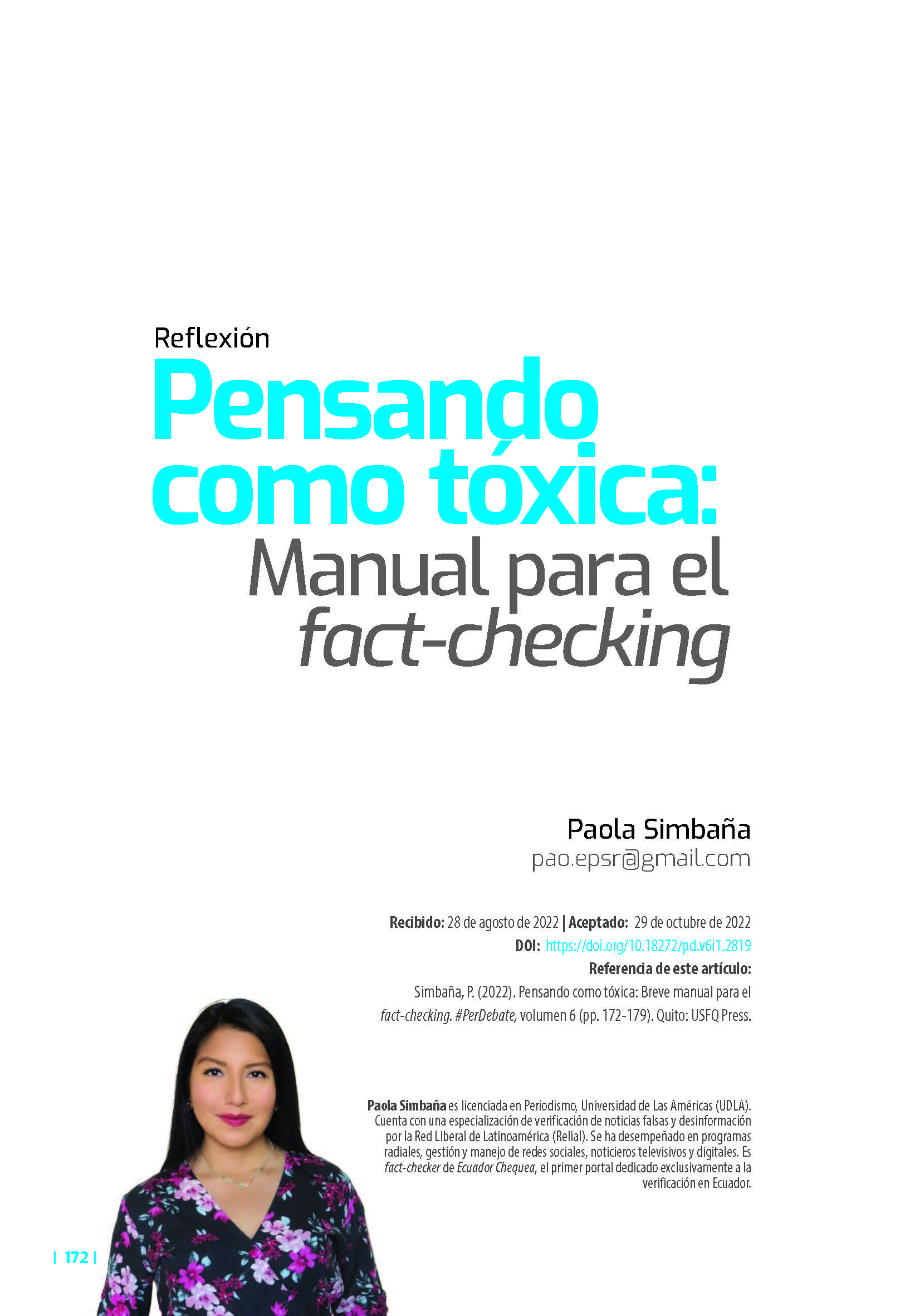
Thinking as toxic: brief manual for fact-checking
Article Sidebar
Main Article Content
Abstract
Misinformation is a hoax. How can we avoid being another victim? Journalists cannot alone against so much disinformation, every digital user must do their part. The key is to submit each post —before sharing it— to the meticulous gaze of someone looking to hunt down an infidel. In this reflective text, some strategies are divided to verify the originality and transparency of information that circulates on the internet and/or social networks. Here is a guide to be toxic in that search and stop the virality of misinformation.
Downloads
Article Details
Section

This work is licensed under a Creative Commons Attribution-NonCommercial 4.0 International License.
Authors who publish in the journal agree to the following terms:
- Authors will retain their copyright and grant the journal the right of first publication of their work. The work will simultaneously be subject to the Creative Commons Attribution License, which allows third parties to share the work provided that its authorship is acknowledged and that its first publication in this journal is cited.
- Authors may enter into additional non-exclusive licensing agreements for the distribution of the published version of the work. This allows them to publish it in a monographic volume or reproduce it in other forms, provided that the initial publication in this journal is acknowledged.
- Authors are permitted and encouraged to disseminate their work through the Internet:
- Before submission to the journal, authors may deposit the manuscript in preprint archives or repositories (preprint servers/repositories), including arXiv, bioRxiv, figshare, PeerJ Preprints, SSRN, among others. This may foster valuable academic exchanges and increase citations of the published work (see The Open Access Effect).
- After submission, authors are encouraged to deposit their article in their institutional repository, personal website, or scientific social networks (such as Zenodo, ResearchGate, or Academia.edu).
How to Cite
References
Global Americans. (2021). Medición del impacto de la información falsa, la desinformación y la propaganda en América Latina: Identificación de fuentes, patrones y redes que propongan las campañas de desinformación extranjeras. Smart News & Research for Latin America’s Changemakers. https://bit.ly/3UHrlrv
Naciones Unidas. (2020, 16 de abril). Noticias falsas y desinformación, otra pandemia del coronavirus. Noticias ONU Mirada global Historias humanas. https://news.un.org/es/story/2020/04/1472922
Simbaña Ramos, P. (2022, 20 de julio). La desinformación también fue protagonista del paro. Ecuador Chequea. https://bit.ly/3LQHxm0