Drácula reserve: an avifaunal hotspot in the Andean chocó of Ecuador
DOI:
https://doi.org/10.18272/reo.vi12.4289Keywords:
Avifauna, Hotspot, altitudinal gradients, Habitat heterogeneity, Conservation, Chocó Biogeographic regionAbstract
Abstract. - Located in Carchi Province, Tulcán Canton, Jijón y Caamaño Parish, the Drácula Reserve is characterized by an altitudinal gradient ranging from 900 to 2400 m a.s.l., generating environmental variation over relatively short distances. This condition promotes high habitat heterogeneity and supports both specialization and richness of avifauna.
Within only nine days of sampling, we recorded 339 individuals corresponding to 160 species across an area of 2162 hectares, representing approximately 9.17% of the avifauna of continental Ecuador. These results reveal a high concentration of species within a relatively small area, positioning the Drácula Reserve as an important hotspot for avifauna.
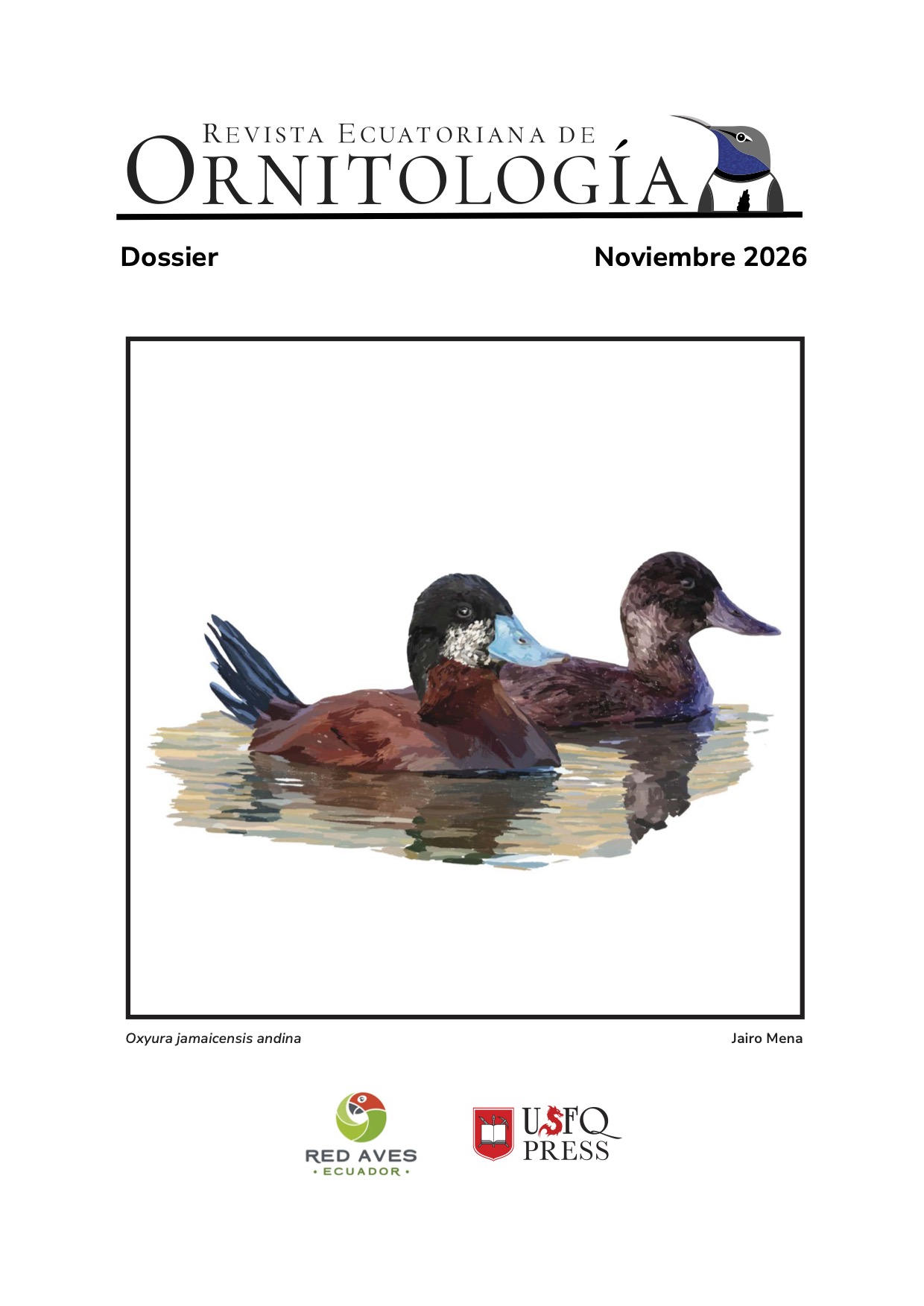
A total of 35 species were recorded under some conservation category. Notable among these are the Andean Eagle (Spizaetus isidori), classified as Critically Endangered at the national level, and the Gorgeted Sunangel (Haplophaedia lugens), considered Vulnerable. Habitat degradation has contributed to the increased vulnerability of these emblematic species.
This study forms part of a broader biodiversity conservation strategy in the binational Mira–Mataje river basins (Colombia–Ecuador), implemented by INABIO and other key partners.
Downloads
References
Este resumen no tiene referencias
Downloads
Published
Issue
Section
License
Copyright (c) 2026 Oswaldo Tejada-Guerrero

This work is licensed under a Creative Commons Attribution-NonCommercial 4.0 International License.
Los autores que publiquen en la Revista Ecuatoriana de Ornitología aceptan los siguientes términos:
- Los autores/as conservarán sus derechos de autor y garantizarán a la revista el derecho de primera publicación de su obra, el cuál estará simultáneamente sujeto a la Licencia de Reconocimiento No Comercial de Creative Commons.
- Los autores/as podrán adoptar otros acuerdos de licencia no exclusiva de distribución de la versión de la obra publicada, pudiendo de esa forma publicarla en un volumen monográfico o reproducirla de otras formas, siempre que se indique la publicación inicial en esta revista.
- Se permite y se recomienda a los autores difundir su obra a través de Internet en su repositorio institucional, página web personal, o red social científica (como ResearchGate o Academia.edu).