
Some lessons from the transition: from analogue to digital journalism
Article Sidebar
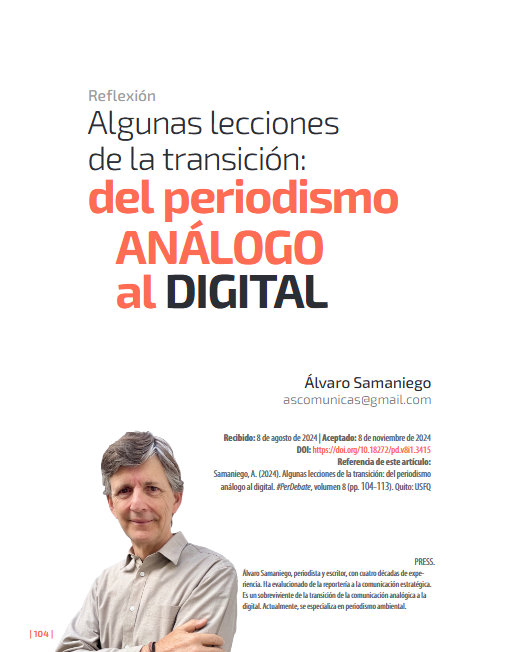
Main Article Content
Abstract
This article reflects on the transition from analog to digital journalism, highlighting the author’s personal experiences. It discusses how technology has transformed reporting, from teletypes to artificial intelligence, and how this evolution has impacted the immediacy and quality of information. The author analyzes the advantages and disadvantages of this shift, noting that although digitalization has democratized access to information, it has also intensified issues such as post-truth and information overload. Additionally, the impact of algorithms and artificial intelligence on perception of reality and social polarization is examined. The article emphasizes the need for digital literacy to address these challenges and reflects on the future of journalism in the digital age.
Downloads
Article Details
Section

This work is licensed under a Creative Commons Attribution-NonCommercial 4.0 International License.
Authors who publish in the journal agree to the following terms:
- Authors will retain their copyright and grant the journal the right of first publication of their work. The work will simultaneously be subject to the Creative Commons Attribution License, which allows third parties to share the work provided that its authorship is acknowledged and that its first publication in this journal is cited.
- Authors may enter into additional non-exclusive licensing agreements for the distribution of the published version of the work. This allows them to publish it in a monographic volume or reproduce it in other forms, provided that the initial publication in this journal is acknowledged.
- Authors are permitted and encouraged to disseminate their work through the Internet:
- Before submission to the journal, authors may deposit the manuscript in preprint archives or repositories (preprint servers/repositories), including arXiv, bioRxiv, figshare, PeerJ Preprints, SSRN, among others. This may foster valuable academic exchanges and increase citations of the published work (see The Open Access Effect).
- After submission, authors are encouraged to deposit their article in their institutional repository, personal website, or scientific social networks (such as Zenodo, ResearchGate, or Academia.edu).
How to Cite
References
Benkler, Yochai. (2006). The Wealth of Networks: How Social Production
Transforms Markets and Freedom. Yale University Press.
Carr, Nicholas (2010). The Shallows: What the Internet Is Doing to Our Brains. W. W.
Norton & Company.
Castells, Manuel. (1996). The Rise of the Network Society. Wiley-Blackwell.
Shirky, Clay. (2008). Here Comes Everybody: The Power of Organizing Without
Organizations. Penguin Books.