
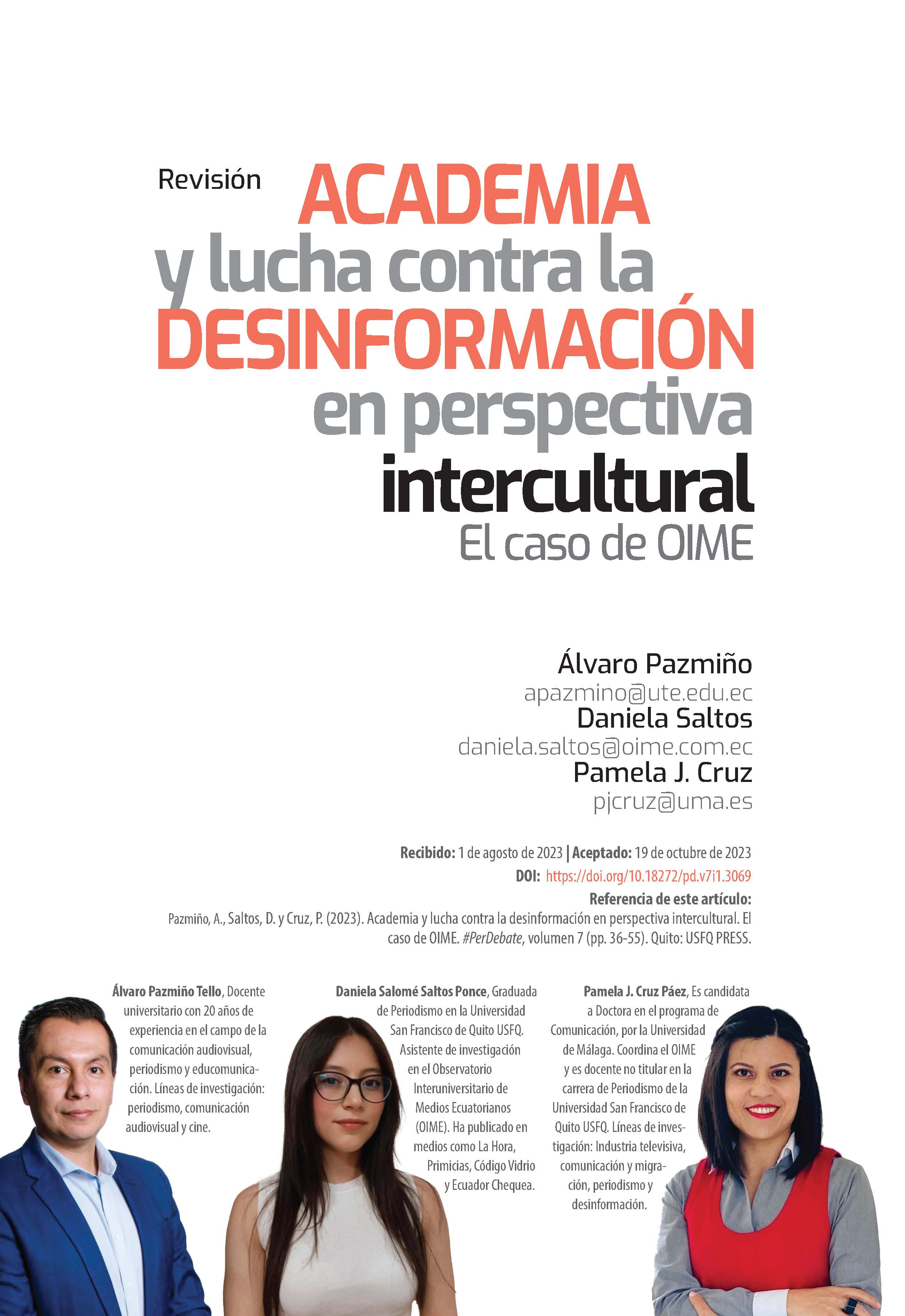
Academia and the fight against misinformation from an intercultural perspective. The OIME
Article Sidebar
Main Article Content
Abstract
This study addresses the global phenomenon of disinformation, which has captured the attention of various entities such as governments, international organizations, the media, civil organizations, and academia. Strategies to combat misinformation are highlighted, such as content curation and fact verification, these actions being carried out mainly from the educational field and the academy. Likewise, the importance of digital literacy is emphasized so that users can discern false information from the truth. As a result of the appearance of the COVID-19 pandemic, the case study of the Interuniversity Observatory of Ecuadorian Media (OIME) exemplifies the role of the Ecuadorian academy in responding to contaminated information from an intercultural perspective, through a model of social cooperation in contexts of crisis. Specifically, in a period from August 2020 to June 2022, the Observatory has produced 15 scientific dissemination notes, 4 graphic elements (interactive infographics and posters) and four informative notes. Continuing with this line, it is pertinent to understand disinformation as false, inaccurate or misleading content designed to cause public harm or private benefits, which has become a series of varied manifestations. However, there is evidence of a challenge in intercultural professional training in Ecuador, given the low percentage of teachers from minority populations in educational institutions. However, the growing interest in research on intercultural content production, political participation, citizen empowerment, among other aspects, stands out. In short, the lack of digital skills and multiliteracy is identified as one of the reasons that facilitates the spread of misinformation among people. Specifically from an educational and communication perspective, interculturality is considered a dialogue under construction between cultures to strengthen identities, recover historical memory and eliminate hierarchies in learning environments with the incorporation of active digital literacy.
Downloads
Article Details
Section

This work is licensed under a Creative Commons Attribution-NonCommercial 4.0 International License.
Authors who publish in the journal agree to the following terms:
- Authors will retain their copyright and grant the journal the right of first publication of their work. The work will simultaneously be subject to the Creative Commons Attribution License, which allows third parties to share the work provided that its authorship is acknowledged and that its first publication in this journal is cited.
- Authors may enter into additional non-exclusive licensing agreements for the distribution of the published version of the work. This allows them to publish it in a monographic volume or reproduce it in other forms, provided that the initial publication in this journal is acknowledged.
- Authors are permitted and encouraged to disseminate their work through the Internet:
- Before submission to the journal, authors may deposit the manuscript in preprint archives or repositories (preprint servers/repositories), including arXiv, bioRxiv, figshare, PeerJ Preprints, SSRN, among others. This may foster valuable academic exchanges and increase citations of the published work (see The Open Access Effect).
- After submission, authors are encouraged to deposit their article in their institutional repository, personal website, or scientific social networks (such as Zenodo, ResearchGate, or Academia.edu).
How to Cite
References
Aguaded, I. y Romero-Rodríguez, L. (2015). Mediamorfosis y desinformación en la infoesfera: Alfabetización mediática, digital e informacional ante los cambios de hábitos de consumo informativo. Education in the Knowledge Society, 16(1). https://doi.org/10.14201/eks20151614457
Constitución de la República del Ecuador. (2008, 20 de octubre). Asamblea de Montecristi. Registro Oficial 449.
Cruz, P., Clavijo, M. & Villacrés, C. (2022). Academia and Media in Ecuador: A Verification and Digital Literacy Alliance Against Disinformation. Atlantis Press, 10.2991/978-2494069-25-1_6
Del-Fresno-García, M. (2019). Desórdenes informativos: sobreexpuestos e infrainformados en la era de la posverdad. El profesional de la información, 28(3), e280302. https://doi.org/10.3145/epi.2019.may.02
European Commission. (2018). A multi-dimensional approach to disinformation. Report of the independent High-Level Group on Fake News and Online Disinformation. Directorate-General for Communication Networks, Content and Technology. Union Europea. http://bit.ly/2Ponxc1
Franco Migues, D. (2016). Cartilla de alfabetización ciudadana: Guía pedagógica para empoderar al ciudadano frente a la publicidad electoral. Unesco / Universidad de Guadalajara. https://bit.ly/3DBowRu
García-Marín, D. (2020). Infodemia global. Desórdenes informativos, narrativas fake y factchecking en la crisis de la Covid-19. Profesional de la información, 29(4), e290411. https://doi.org/10.3145/epi.2020.jul.11
Gartner. (2017). Gartner Top 10 Strategic Technology Trends for 2018. Gartner. https://bit.ly/3FrL08m
Guallar, J., Codina, L., Freixa, P. y Pérez-Montoro, M. (2020). Desinformación, bulos, curación y verificación: Revisión de estudios en Iberoamérica 2017-2020. Telos: Revista de Estudios Interdisciplinarios en Ciencias Sociales, 22(3), 595-613. https://doi.org/10.36390/telos223.09
Krainer, A. y Guerra, M. (2016). Interculturalidad y educación: Desafíos docentes. FLACSO Ecuador. https://bit.ly/44Mhs0a
Livingstone, S. & Haddon, L. (2009). EU Kids Online: Final Report. The London School of Economics and Political Science. https://bit.ly/3q8qyoP
Martínez Roa, O., Guzmán Rodríguez, C. H. y Lara Avilés, G. L. (2023). Una revisión sistemática de la comunicación para el cambio social (2015-2021).
Cuadernos.info, (55), 332-354. https://doi.org/10.7764/cdi.55.56201
Monje Álvarez, C. A. (2011). Metodología de la investigación cuantitativa y cualitativa: Guía didáctica. Universidad Surcolombiana. https://bit.ly/3DEYpc0
Orbe, T., Cruz, P., Cabrera, S., Herrera, F., Villacrés, C., Cárdenas, M., Clavijo, M., Cañar, M. y Pérez, J. (2022). Desinformación en tiempos de COVID-19: Investigación desde el Observatorio Interuniversitario de Medios Ecuatorianos, OIME en Escobar (Ed), Pandemia y nuevas realidades para la comunicación en Ecuador (pp. 235-265). Ciespal.
Rivadeneyra Arboleda, M. D. y Cruz Páez, P. J. (2021). Desinformación y Covid-19 entre millennials ecuatorianos: Del consumo de memes a propuestas informativas de humor. Revista Enfoques de la Comunicación, (5), 71-118. https://bit.ly/3F4vP4G
Rizo García, M. (2013). Comunicación e interculturalidad: Reflexiones en torno a una relación indisoluble. Global Media Journal, 10(19), 26-42. https://bit.ly/3DynYLR
Rodríguez-Pérez, C. (2020). Una reflexión sobre la epistemología del fact-checking journalism: retos y dilemas. Revista de Comunicación,
(1). https://doi.org/10.26441/RC19.1-2020-A14
Salaverría, R., Buslón, N., López-Pan, F., León, B., López-Goñi, I. y Erviti, M. C. (2020). Desinformación en tiempos de pandemia: Tipología de los bulos sobre la Covid-19. Profesional de la información, 29(3). https://doi.org/10.3145/epi.2020.may.15
Unesco. (2019). Fortalecimiento del diálogo intercultural: mejores conocimientos para un diálogo mejor. Unesco. https://bit.ly/3rK25qh
Unesco. (2020a). Desinfodemia: descifrando la desinformación sobre el COVID-19. Unesco. http://bit.ly/3Xp13vM
Unesco. (2020b). Desinfodemia: Disección de las respuestas a la desinformación sobre el COVID-19. Unesco. https://bit.ly/3qcEUEU
Unesco. (2023). Qué debe saber sobre la alfabetización. Unesco. https://bit.ly/3rHD53b