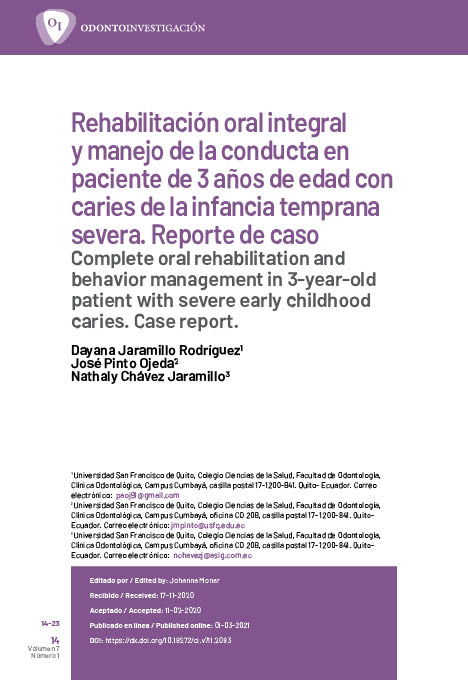
Complete oral rehabilitation and behavior management in 3-year-old patient with severe early childhood caries. Case report.
Article Sidebar
Main Article Content
Abstract
Non-pharmacological behavior management techniques are the set of procedures aimed to improve a child's coping skills and, are useful for complete oral rehabilitations as they decrease fear and anxiety levels while facilitating the proper realization of treatment. Before starting dental procedures, the child must be evaluated to recognize his cooperation and psychological maturity degree, in this way we will be able to choose the techniques that best suit the patient. The efficacy, safety, and preference of parents for the use of these techniques versus sedation or general anesthesia has been reported. The objective of this clinical case is to demonstrate that, through a correct selection of basic behavioral management techniques, the collaboration and acceptance of treatment by a 3-year-old patient with previous negative dental experiences and severe early childhood caries was achieved.
Article Details
Section
Los autores que publiquen en esta revista aceptan los siguientes términos:
- Los autores conservarán sus derechos de autor y garantizarán a la revista el derecho de primera publicación de su obra, el cuál estará simultáneamente sujeto a la Licencia de reconocimiento de Creative Commons que permite a terceros compartir la obra siempre que se indique su autor y su primera publicación esta revista.
- Los autores/as podrán adoptar otros acuerdos de licencia no exclusiva de distribución de la versión de la obra publicada (p. ej.: depositarla en un archivo telemático institucional o publicarla en un volumen monográfico) siempre que se indique la publicación inicial en esta revista.
- Se permite y recomienda a los autores/as difundir su obra a través de Internet (p. ej.: en archivos telemáticos institucionales o en su página web) antes y durante el proceso de envío, lo cual puede producir intercambios interesantes y aumentar las citas de la obra publicada. (Véase El efecto del acceso abierto).