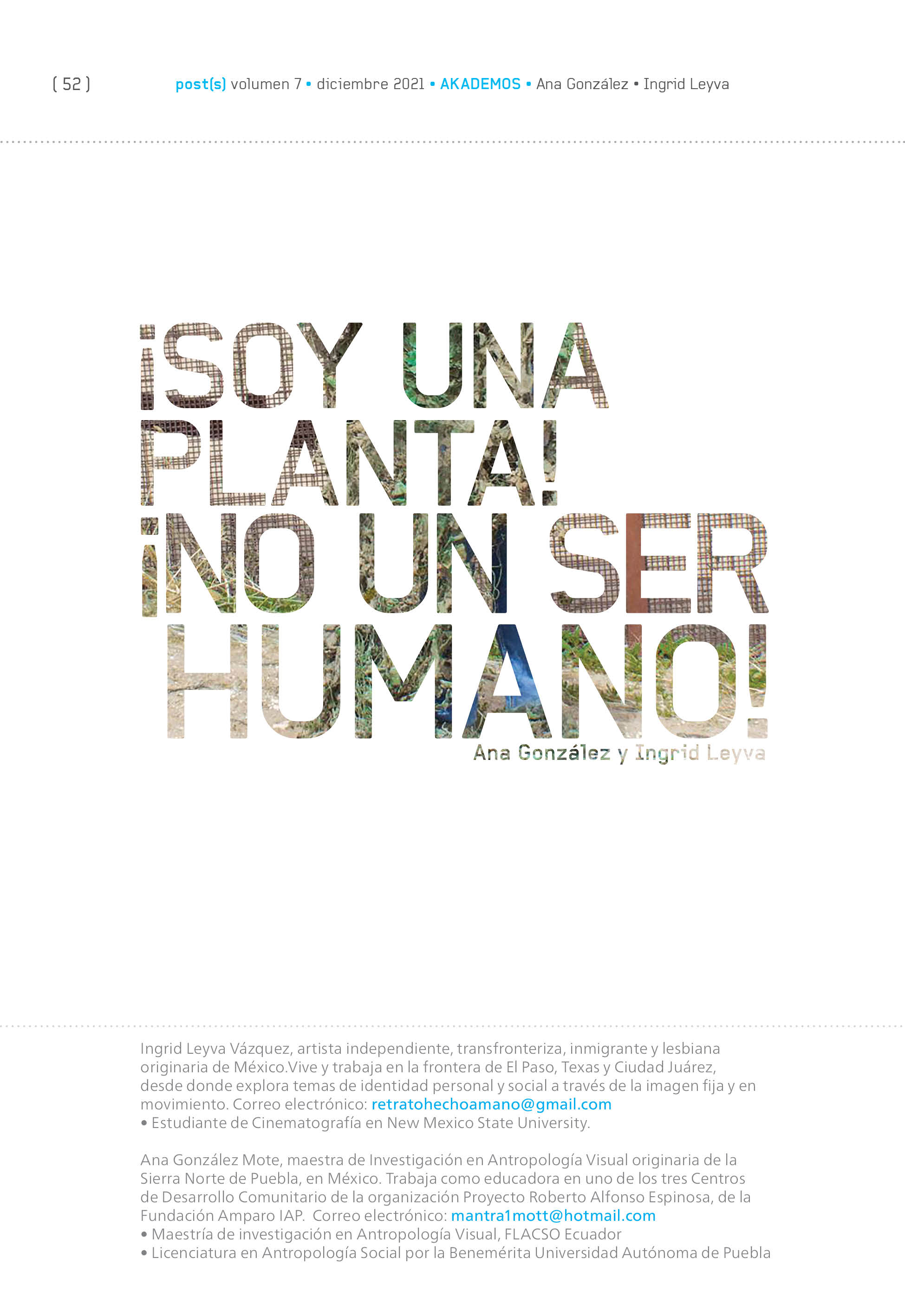
I am a plant! Not a human being! I am a plant! Not a human being!
Published 2021-12-13
How to Cite
Share
Downloads
Copyright (c) 2021 Ana Elizabeth González Mote & Ingrid Leyva Vázquez

This work is licensed under a Creative Commons Attribution-NonCommercial-ShareAlike 4.0 International License.
Societal impact
Our analysis is guided by the question: Why be a plant and not a human being? We divided the response into 4 sections. The first of the responses presents the way in which we integrate as a collective and the foundation that we have in common to present the question; the second presents a historical context describing how border crossings have been shaped through institutions in order to describe a contemporary landscape; the third part includes NAFTA (North American Free Trade Agreement) into the discussion between the crossings of human and non-human bodies; the fourth part is directed to the analysis of the avocado as a non-human body that allows us to show the absurdity of anti-immigrant policies. Finally, we conclude with a reflection of the collaborative and interdisciplinary process and of the aesthetic principles that support the bases of our proposal.
">Abstract
In this text we share the collaborative process and research in which our collective "Aliens Anyways" -formed by Ingrid Leyva and Ana Mote- explores the relationship between the bodies, borders and crossings from Cd. Juarez, Chihuahua in Mexico and El Paso, Texas in the United States.
Our analysis is guided by the question: Why be a plant and not a human being? We divided the response into 4 sections. The first of the responses presents the way in which we integrate as a collective and the foundation that we have in common to present the question; the second presents a historical context describing how border crossings have been shaped through institutions in order to describe a contemporary landscape; the third part includes NAFTA (North American Free Trade Agreement) into the discussion between the crossings of human and non-human bodies; the fourth part is directed to the analysis of the avocado as a non-human body that allows us to show the absurdity of anti-immigrant policies. Finally, we conclude with a reflection of the collaborative and interdisciplinary process and of the aesthetic principles that support the bases of our proposal.
Keywords
- Bodies,
- Crossings,
- Border,
- Creative process,
- Aliens
- migration ...More
References
- Associated Press. (2020). Aumentan cruces ilegales en la frontera de EEUU-México. Los Angeles Times. https://www.latimes.com/espanol/eeuu/articulo/2020-11-19/aumentan-cruces-ilegales-en-frontera-de-eeuu mexico
- Diario Oficial de la Nación. (1993). Decreto de promulgación del Tratado de Libre Comercio de América del Norte. https://www.legiscomex.com/BancoMedios/Documentos%20PoDF/tlcan1.pdf
- García Pereyra, R. (2013). Ciudad Juárez la fea. Tradición de una ciudad estigmatizada. Fabro Editores.
- Gómez Mena, C. (2021). Pese a pandemia, incrementaron exportaciones de aguacate: APEAM. La Jornada. https://www.jornada.com.mx/notas/2021/01/15/economia/pese-a-pandemia-incrementaron-exportaciones-de-aguacate-apeam/
- González Herrera, C. (2009). El puente Santa Fe: Ellis Island del desierto. En Pérez-Tylor, González, y Chávez (Eds.), Antropología del desierto. Desierto, adaptación y formas de vida. El Colegio de Chihuahua/UACJ/CA36 Estudios Históricos.
- González de la Vara, M. (2009). Breve historia de Ciudad Juárez y su región. El Colegio de Michoacán.
- Haraway, D. J. (1995). Conocimientos situados: la cuestión científica en el feminismo y el privilegio de la perspectiva parcial. En Ciencia, cyborgs y mujeres. La invención de la naturaleza. Cátedra.
- Naciones Unidas. (2020). La pandemia del coronavirus enmascara la cifra de 1200 migrantes muertos en el primer semestre de 2020. Noticias ONU-Mirada Global Historias Humanas. https://news.un.org/es/story/2020/08/1478902
- Rendón, R., Rodríguez, J., y Lara, Y. (2017). Migración en tránsito por la microrregión trasfronteriza Altar. Control, militarización y vulnerabilidad en la movilidad humana. En Padilla, Zacaula, Netzahualcoyotzi y Sandoval (Coords.), Las fronteras: espacios estratégicos para la globalización. Universidad Autónoma de Ciudad Juárez. Benemérita Universidad Autónoma de Puebla, 301-344.
- Robinson, A. (2020). Oro, petróleo y aguacates. Las nuevas venas abiertas de América Latina. Editorial Arpa.
- Valencia, S. (2019). El régimen está (trasmitiendo en) vivo. En Sizman y Posada, Re-visiones. Visualidades críticas: ecologías culturales y saberes del común.