
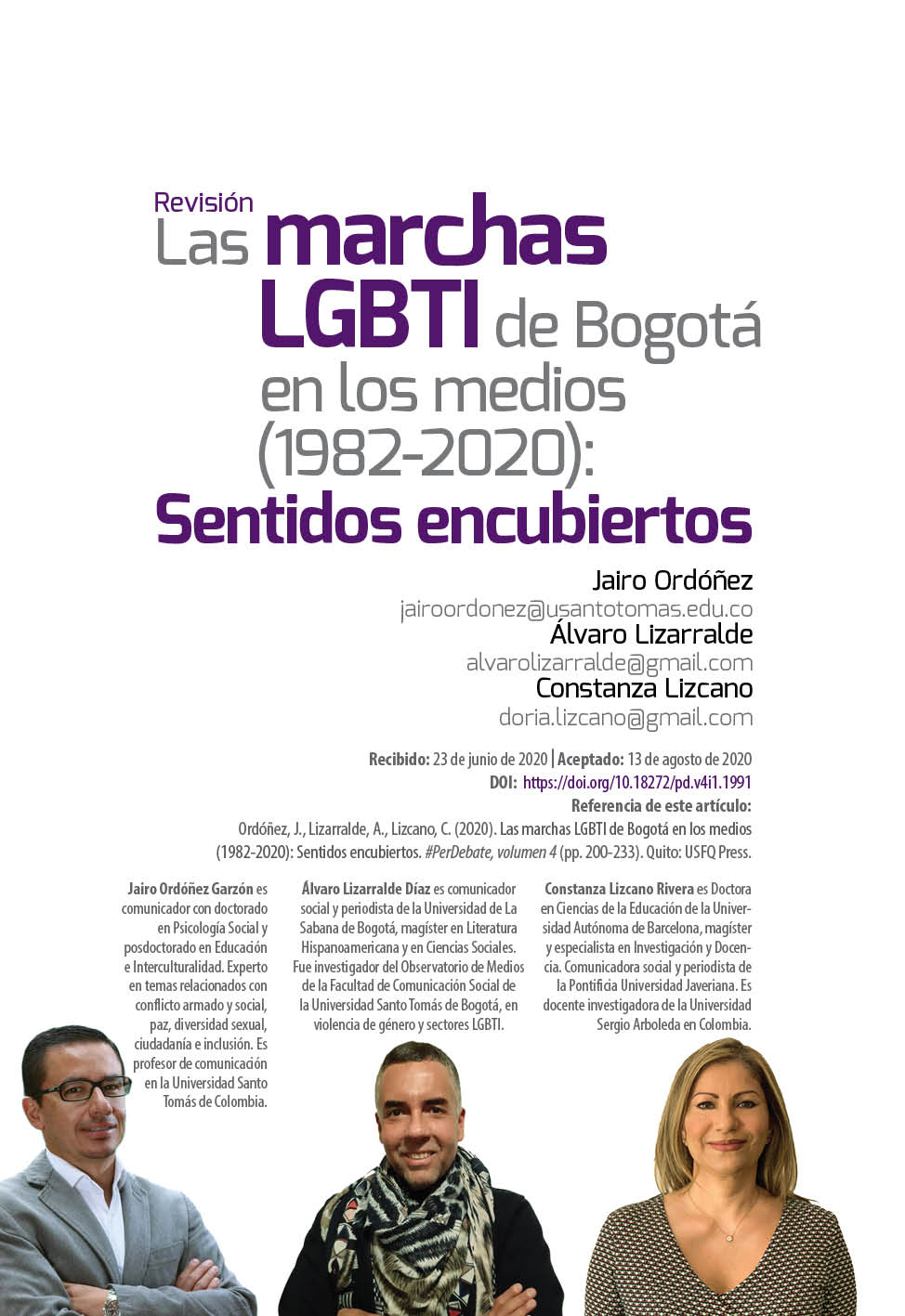
The LGBTI Marches of Bogotá in the Media (1982-2020) Covert Senses
Article Sidebar
Published:
2020-11-06
How to Cite
Ordóñez Garzón, J. E., Lizarralde Díaz, Á., & Lizcano Rivera, C. (2020). The LGBTI Marches of Bogotá in the Media (1982-2020): Covert Senses. #PerDebate, 4(1), 200-233. https://doi.org/10.18272/pd.v4i1.1991
Downloads
Download data is not yet available.
Societal impact
Main Article Content
Abstract
This research analyzed the coverage of the Marches for Sexual and Gender Diversity, formerly known as Gay Pride Marches, in Bogotá, based on ten representative media from this city, some of them national in scope. The objective was to determine how the marches were recorded by journalists, both in the general mass media and in those specialized in LGBTI issues, understanding that media are catalysts for stereotypes and prejudices in society. Thus, articles between 1982 and 2018 were analyzed (in 2019 the march was suspended due to a storm and in 2020 due to COVID-19), in order to identify modes, trends and changes in the way of reporting. The method for this research was mainly content analysis, although discourse analysis and critical discourse analysis were also implemented. The approach was quantitative and descriptive in scope. As relevant conclusions, characteristics in journalistic coverage were identified, especially in traditional media, such as misinformation, incomplete information, an elitist approach, limited coverage and approach, which implies an
invisibility and depoliticization of a march that is represented as a mere show. On the other hand, a more in-depth coverage is observed in the medium specialized in LGBTI issues. This research was carried out with resources provided by Universidad Santo Tomás in Colombia.
Keywords:
LGBTI, diversity marches, Mass Media, coverage, Bogota
Article Details
References
Authors who publish in the journal agree to the following terms:
- Authors will retain their copyright and grant the journal the right of first publication of their work. The work will simultaneously be subject to the Creative Commons Attribution License, which allows third parties to share the work provided that its authorship is acknowledged and that its first publication in this journal is cited.
- Authors may enter into additional non-exclusive licensing agreements for the distribution of the published version of the work. This allows them to publish it in a monographic volume or reproduce it in other forms, provided that the initial publication in this journal is acknowledged.
- Authors are permitted and encouraged to disseminate their work through the Internet:
- Before submission to the journal, authors may deposit the manuscript in preprint archives or repositories (preprint servers/repositories), including arXiv, bioRxiv, figshare, PeerJ Preprints, SSRN, among others. This may foster valuable academic exchanges and increase citations of the published work (see The Open Access Effect).
- After submission, authors are encouraged to deposit their article in their institutional repository, personal website, or scientific social networks (such as Zenodo, ResearchGate, or Academia.edu).