Artículos
Selection of sleeping perches by the Gem Anole, Anolis gemmosus O’Shaughnessy 1875, in a cloud forest in Ecuador
Selección de perchas para dormir por el Anolis Gema, Anolis gemmosus O’Shaughnessy 1875, en un bosque nublado en Ecuador

Selection of sleeping perches by the Gem Anole, Anolis gemmosus O’Shaughnessy 1875, in a cloud forest in Ecuador
Avances en Ciencias e Ingenierías, vol. 18, núm. 1, pp. 1-11, 2026
Universidad San Francisco de Quito

Esta obra está bajo una Licencia Creative Commons Atribución 4.0 Internacional.
Recepción: 05 Agosto 2024
Aprobación: 27 Agosto 2025
Publicación: 06 Abril 2026
Abstract: The selection of sleeping perches plays a critical role in predator avoidance, territorial defense, access to feeding areas, and reaching breeding sites. This behavior has been widely studied across various taxa, including the diverse lizard genus Anolis. For Anolis gemmosus, however, only one previous study has addressed sleeping perch selection, focusing solely on physical variables of the perches. In this study, we incorporate additional variables—such as the sex and size of the lizards—and assess their effect on perch type and leaf area. Our results reveal a significant relationship between individual size, particularly in males, and perch area. This pattern may reflect strategies for predator avoidance, or territory maintenance, or may simply result from the higher availability of leaves within a specific range of area in the habitat of A. gemmosus.
Keywords: Sleep ecology, predator avoidance, Iguanidae, Anolinae, territoriality, habitat use.
Resumen: La selección de perchas para dormir es importante como estrategia para evitar depredadores, defender territorio y acceder a áreas de alimentación y de reproducción. Este tema ha sido estudiado extensamente en diferentes grupos de organismos, incluyendo el diverso grupo de lagartijas del género Anolis. Para Anolis gemmosus solo existe un estudio acerca de la selección de perchas para dormir, pero solo toma en cuenta las variables físicas de las perchas. En este estudio tomamos en cuenta nuevas variables como sexo y tamaño de las lagartijas, estudiando su efecto en el tipo de percha y el área de la hoja. Nuestros resultados indican que existe una relación significativa entre el tamaño de los individuos, especialmente los machos, con respecto al área de percha. Este patrón podría reflejar a una estrategia para evadir depredadores, mantener territorios, o podría resultar de una mayor disponibilidad de hojas con un rango de área específica en el hábitat de A. gemmosus.
Palabras clave: Ecología del sueño, evasión de predadores, Iguanidae, Anolinae, territorialidad, uso de hábitat.
INTRODUCTION
All animal species engage in some form of rest or sleep to conserve energy, restore neural functions, and reduce the risk of predation [1, 2]. Research on sleep behavior has examined specific sleep patterns, durations, preferred locations, and general behaviors, which have been reviewed across several animal groups [3, 4, 5]. In lizards, studies have primarily focused on the selection of sleeping perches, considering factors such as perch stability and temperature, predator detection, the relationship between body size and perch height or diameter, and perch orientation relative to the ground [6, 7, 8, 9, 10]. Different lizard species have developed a variety of sleep strategies, mainly to enhance predator avoidance while sleeping, defend their territories, access foraging areas, and reach breeding sites [11, 12, 13, 14].
Among lizards, species from the genus Anolis are particularly well-suited for research on sleep ecology because of their ease of detection while sleeping [10, 11, 12, 15, 16, 17, 18, 19, 20, 21, 22, 23, 24, 25]. In general, Anolis lizards prefer to sleep on branches, stems, and leaves of ferns, trees, grasses, and shrubs at various levels of the forest strata [1, 10, 12, 15, 25]. The Gem Anole, Anolis gemmosus O’Shaughnessy 1875, is a commonly encountered diurnal species found in both primary and secondary rainforests across the western Andes of Ecuador and Colombia, at elevations ranging from 1177 to 2468 m a.s.l. [26]. The abundance of A. gemmosus in Ecuador, along with their visibility during sleep, makes it an excellent candidate for investigating lizard sleeping behavior.
While there is information on the sleeping behavior of certain Anolis species, only one study has investigated the sleeping habits of A. gemmosus. That study focused on perch characteristics such as vertical distribution, the orientation of individuals on the perch, and tail position, aiming to test niche overlap with other Anolis species. However, this study did not consider factors such as the sex or size of individuals and was based on a small sample of only nine lizards [27].
The primary objective of this study is to determine whether individual size and sex influence the type and area of leaves selected as sleeping perches of A. gemmosus, thereby complementing the findings of the only available study on the species’ sleep ecology [27]. I hypothesize that (1) body size (SVL) and sex will influence the perch type or perch area selected [12, 18]. And (2) both sexes will exhibit sleeping site fidelity [14, 16, 18]. This research aims to provide novel insights into the natural history and ecology of this understudied species.
MATERIAL AND METHODS
This study was conducted at Bosque Protector Río Guajalito, a privately-owned nature reserve encompassing 765 ha of cloud forest in the province of Santo Domingo de los Tsáchilas, Ecuador. The reserve is situated at the 59-kilometer mark on the QuitoChiriboga-Santo Domingo Road and is co-owned by various entities including Bisocial, Fundación Salvar Tierra, Fundación Jocotoco, Aves y Conservación and private individuals. It spans across the provinces of Pichincha and Santo Domingo de los Tsáchilas, with elevations ranging from 1800 to 2400 m a.s.l. The area is predominantly composed of pristine cloud forest, although human-disturbed landscapes such as cattle-grazing grasslands are present along its borders [28].
Between January 8 and 25, 2021, I conducted nightly surveys from 20:00 to 24:00 h along the primary ecotourism trail inside Bosque Protector Río Guajalito, totaling 68 hours of field observations. This trail passes through forested areas and a few creeks and is not affected by the main road. The elevational range along the trail varies between 1900 and 2000 m a.s.l. (Fig 1). I selected this time frame because all individuals are expected to be asleep, and the absence of human activity minimizes potential disturbances.
While free walking along the trail, I searched for sleeping A. gemmosus individuals along the trail’s edge, using headlamps for illumination. Upon each encounter, I photographed the sleeping lizard and its perch. I then captured the lizard and measured the snout-vent length (SVL) from the tip of the snout to the cloaca —using a Vinca DCLA-0605 digital caliper with an accuracy of ±0.03. To facilitate individual identification and assess the potential for sleeping site fidelity through recaptures on subsequent nights, I marked each lizard on the dorsum with a unique number, using a black non-toxic marker. Sex was determined based on the species’ clear sexual dimorphism: adult males display a distinct and colorful dewlap, while adult females possess a grey band across their back and lack a dewlap [26]. Age was not considered in the analysis due to the small sample size of juveniles; only adults were included. For perch measurements, I photographed each leaf used as a sleeping perch. Leaf area was calculated using ImageJ software [29]. Leaf length and width measurements were used as scale references.
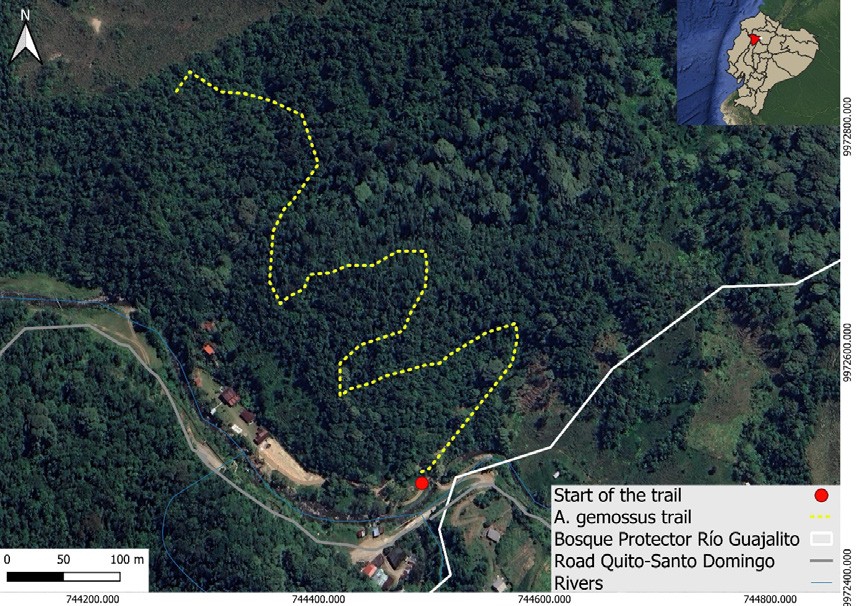
FIGURE 1
Map of the study area showing the Quito-Santo Domingo de los Tsáchilas road to the south, the boundaries of the Bosque Protector Río Guajalito in white, the trailhead marked with a red dot, and the surveyed trail used to search Anolis gemmosus indicated by a yellow dotted line.
FIGURE 1. Map of the study area showing the Quito-Santo Domingo de los Tsáchilas road to the south, the boundaries of the Bosque Protector Río Guajalito in white, the trailhead marked with a red dot, and the surveyed trail used to search Anolis gemmosus indicated by a yellow dotted line.
I categorized the perch types based on the plant species that served as sleeping sites by the lizards. These categories included: (A) perches with long and narrow leaves, typical of most grasses; (B) perches with long and broad leaves, resembling oblong-shaped leaves; (C) perches consisting of compound leaves and small leaflets, such as those found in many fern species; (D) perches with notably large leaves, such as those of Gunnera spp.; (E) perches consisting of stems (Fig 2). It is essential to emphasize that this study did not involve the collection of any plant or animal specimens.
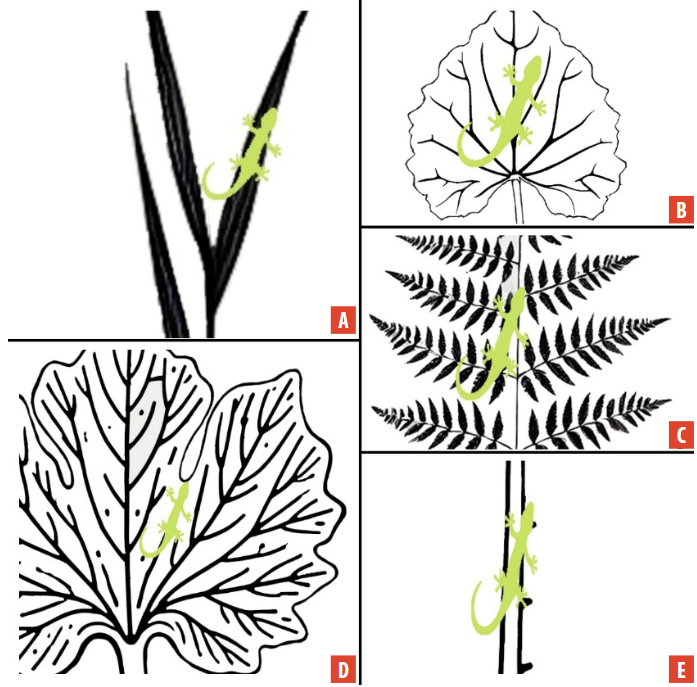
FIGURE 2
Examples of perch types used by Anolis gemmosus: A Long and narrow leaves (e.g., grasses); B long and broad oblong leaves; C compound leaves (e.g., ferns); D large leaves; and E stems.
FIGURE 2. Examples of perch types used by Anolis gemmosus: A Long and narrow leaves (e.g., grasses); B long and broad oblong leaves; C compound leaves (e.g., ferns); D large leaves; and E stems.
Given that observed lizards were predominantly resting on leaves (Fig. 3), I proceeded to label and identify each plant on which they were found. To facilitate plant identification, I consulted a field guide detailing the common plant species of Bosque Protector Río Guajalito [30]. However, for plants that lacked flowers, identification was limited to the genus level. Lizards found sleeping on these plants were still included in the analyses
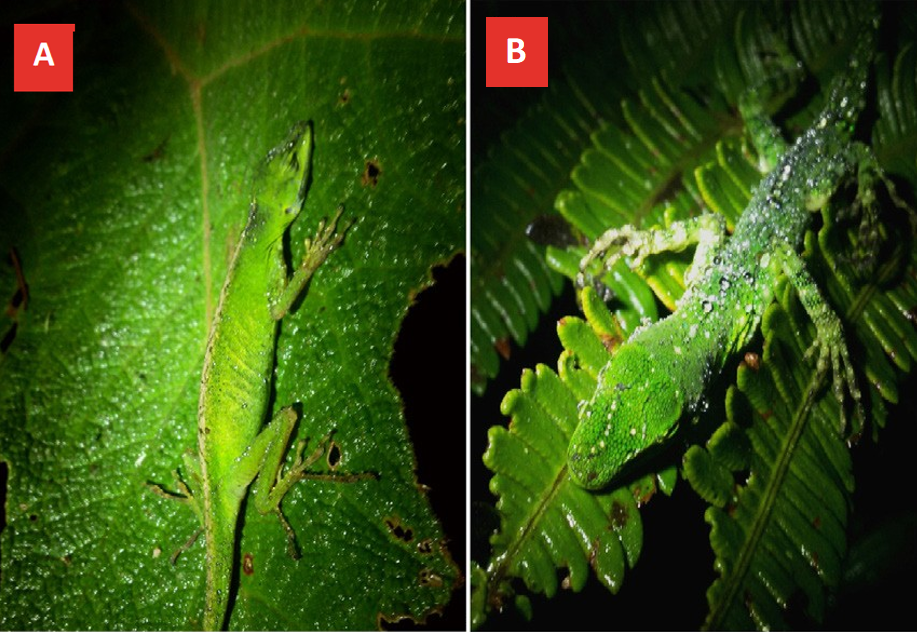
FIGURE 3
A Adult female of Anolis gemmosus (SVL = 55 mm) sleeping on the giant leave of Gunnera atropurpurea (perch type D). B Adult male of Anolis gemmosus (SVL = 60 mm) sleeping on the leaves of the fern Thelypteris semilunata (perch type C). Photographs by Martín Carrera.
FIGURE 3. A Adult female of Anolis gemmosus (SVL = 55 mm) sleeping on the giant leave of Gunnera atropurpurea (perch type D). B Adult male of Anolis gemmosus (SVL = 60 mm) sleeping on the leaves of the fern Thelypteris semilunata (perch type C). Photographs by Martín Carrera.
First, to test whether lizard body size and sex (explanatory variables) influence the perch type (response variable) used as a perch, I performed a multinomial logistic regression model. The perch type was treated as a factor with five categories (Fig. 2). Posteriorly, I computed odds ratios to interpret the effects of body size and sex on perch type selection, and Wald tests were used to assess statistical significance of model coefficients. Second, to evaluate whether lizard body size and sex (explanatory variables) influence the perch area (response variable), I performed several linear regressions, first without separating by sex, and then separating males and females to explore potential relationships between body size and the perch area separated by sex. All statistical analyses were performed using the default analytical package Stats of R Statistical analysis software version 4.1.1 [31].
RESULTS
I encountered a total of 46 lizards (14 males and 32 females), primarily resting on the leaves of 16 different plant species (Table 1). No individuals were recaptured during the entire study. Females were found sleeping mainly on perch types B and C, each accounting for nine females, followed by perch type D for seven females, perch type A for six females, and finally perch type E for one female. In the case of males, six individuals were found in perch type C, followed by perch type D for four males, perch type B for three males, and finally perch type A for one male.
TABLE 1. Plant species used as sleeping perches by Anolis gemmosus. The second column shows the perch type: A Long and narrow leaves (e.g., grasses); B long and broad oblong leaves; C compound leaves (e.g., ferns); D large leaves; and E stems.
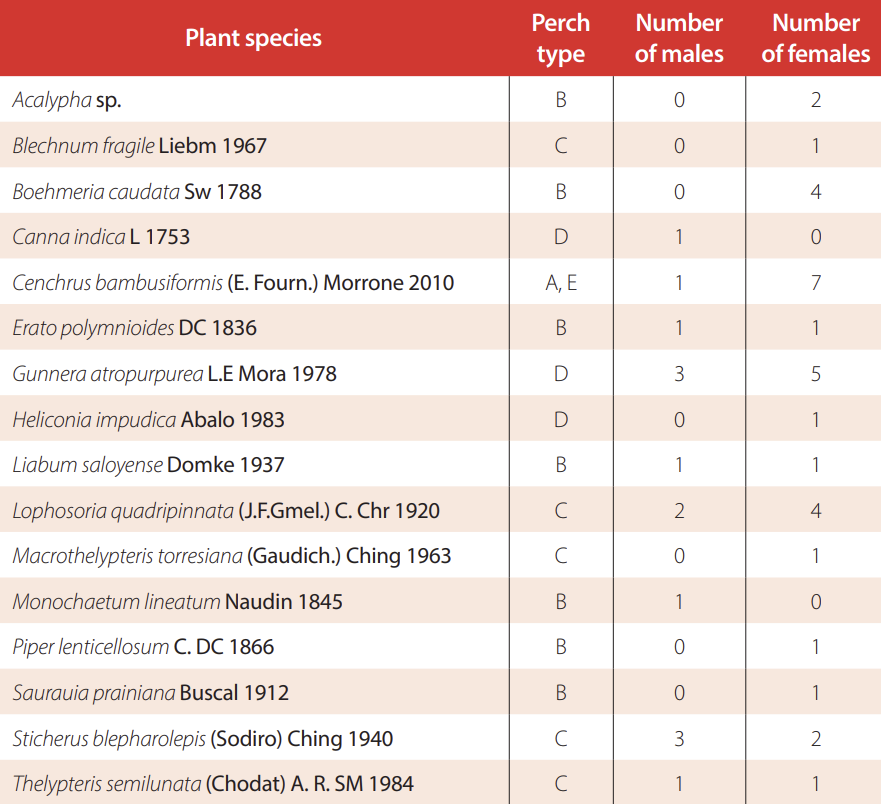
TABLE 1
Plant species used as sleeping perches by Anolis gemmosus. The second column shows the perch type: A Long and narrow leaves (e.g., grasses); B long and broad oblong leaves; C compound leaves (e.g., ferns); D large leaves; and E stems.
The multinomial logistic regression model revealed that body size had a significant effect on the selection of perch type D compared to perch type A (estimate = 0.14, p = 0.038), with an odds ratio of 1.15, suggesting that larger individuals were more likely to use perch type D. Sex had no significant effect on leaf type selection in any of the comparisons (p > 0.35). These findings indicate that lizard body size, but not sex, influences the selection of perch type D (Fig 4).
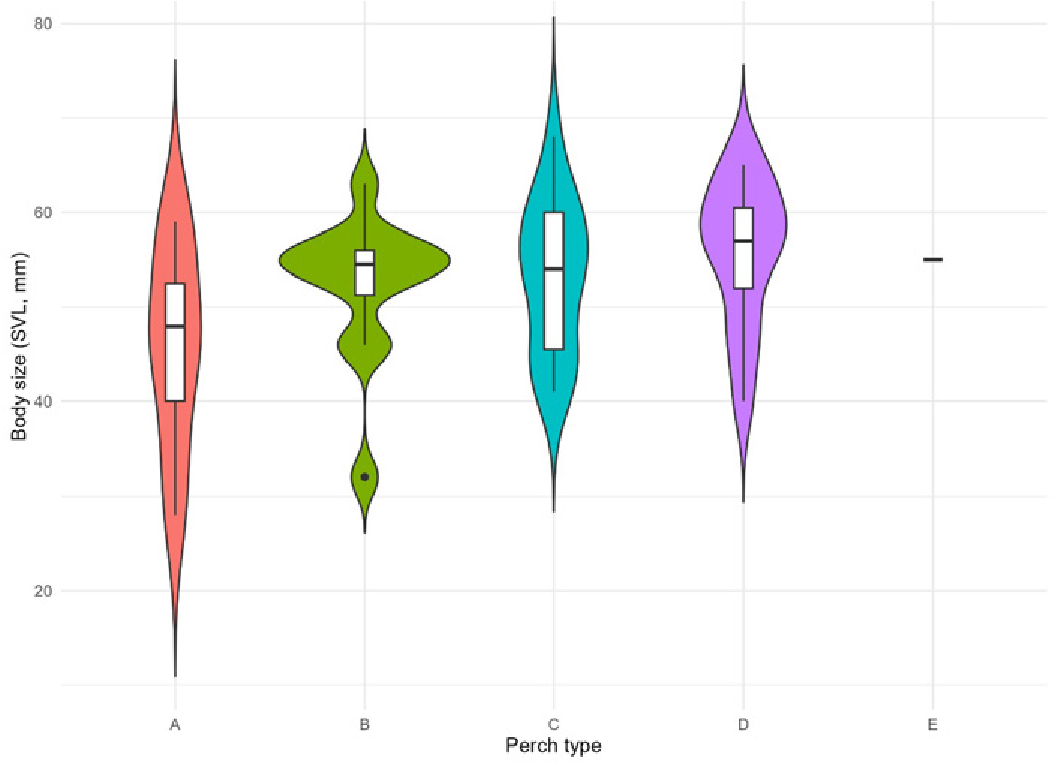
FIGURE 4
Distribution of lizard’s body size (SVL) on each perch type selected.
FIGURE 4. Distribution of lizard’s body size (SVL) on each perch type selected.
The linear regressions showed that neither body size, sex, nor their interaction had a significant effect on the perch area (p > 0.2 for all the variables and interaction). When analysed separately by sex, body size significantly predicted the perch area used by male lizards (R² = 0.30, F (1, 12) = 5.13, p = 0.043), with larger individuals selecting larger leaves as perches. In contrast, no significant relationship was found for females (R² = 0.05, F (1, 29) = 1.58, p = 0.220). These results suggest that the relationship between body size and perch area may differ between sexes (Fig 5).
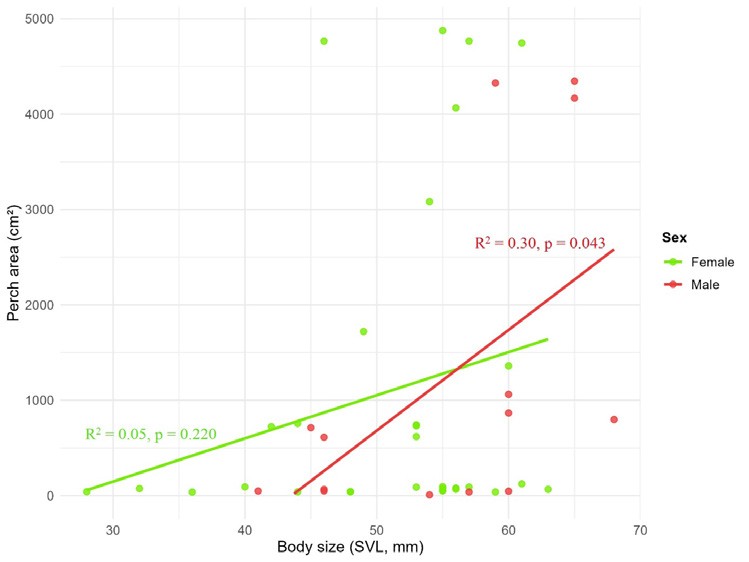
FIGURE 5
Linear regressions between lizard body size (SVL in mm) and perch area (cm²), separated by sex.
FIGURE 5. Linear regressions between lizard body size (SVL in mm) and perch area (cm²), separated by sex.
DISCUSSION
This study investigated how body size and sex influence perch selection in A. gemmosus, focusing on the type and area of leaves used as perches. Both factors play important roles, but their effects differ depending on the aspect of perch use considered. The multinomial logistic regression indicated that lizard body size significantly influenced perch type selection, with larger individuals showing a tendency to perch on type D perches, associated with larger surface areas. However, sex did not emerge as a significant predictor for perch type choice in this model. In contrast, when we consider perch size, the linear regression showed that only in males, perch area increased significantly with body size. This sex-specific pattern suggests that male lizards may be more selective as they grow larger.
Furthermore, selecting specific sleeping perches likely plays a key role in several ecological functions, including antipredator behavior, thermoregulation, and territoriality. For example, choosing sleeping sites in the mid-vegetation strata is a common antipredator strategy in Anolis species [13, 14], as movements in leaves and stems can alert lizards to approaching predators, enhancing escape success [10]. In Anolis gemmosus at Bosque Protector Río Guajalito, known predators include diurnal snakes such as Atractus gigas, Chironius monticola, and Erythrolamprus epinephelus [28]. Although these snakes are diurnal, nocturnal predators like bats, owls, or nocturnal snakes may still pose a risk [14]. In this context, not only the perch area but also the shape may offer functional advantages. For instance, narrower or more elongated leaves might enhance early predator detection by transmitting vibrations more effectively, or they may allow lizards to position themselves more optimally for a quick escape [14, 27].
Thermoregulation may also influence perch choice. Although studies on nocturnal thermoregulation in Anolis lizards are scarce, findings from the highland species A. heterodermus show that daytime microhabitat use is influenced by body temperature [32]. Given that lizards may undergo voluntary hypothermia to conserve energy, it is plausible that A. gemmosus selects sleeping perches with specific areas that provide an optimal body temperature [10, 16, 33], nevertheless, more research about perch characteristics, such as texture and temperature, is needed. Additionally, territorial behavior could contribute to perch selection patterns, as many Anolis species exhibit territory-based spatial use [10, 11, 24, 34]. For instance, in A. gingivinus, females reuse sleeping perches within smaller home ranges, while males occupy larger territories and avoid reusing sites [19]. In this study, I did not recapture individuals, preventing comparisons of site fidelity; however, a marked female with an eye injury was observed sleeping in the same area on two non-consecutive nights. While anecdotal, this observation suggests that some individuals may exhibit site fidelity, warranting further investigation.
SUMMARY AND CONCLUSION
Previous studies have suggested that various factors such as individual size, sex, perch type, individual position in the sleeping perch, perch height, and plant species that Anolis use to sleep play crucial roles in the selection of sleeping perches [18]. However, this study suggest that both leaf area and perch type might influence the selection, particularly on males. Nevertheless, to gain a deeper understanding of the sleeping perch selection patterns in A. gemmosus, further sampling efforts are required considering other variables such as plant species density, physiological aspects like temperature, perch temperature, predatory avoidance, and territoriality by recaptures to test properly if there is a perch selection based on those criteria. Additionally, given the high abundance of A. gemmosus individuals in the Bosque Protector Río Guajalito, it is essential to capture and mark a higher number of individuals to have a larger sample size.
ACKNOWLEDGEMENTS
I would like to thank Vlastimil Zak, manager and co-owner of Bosque Protector Río Guajalito reserve, who helped us identifying several plant species. I thank Cliciani Neira (WCS-Ecuador) for her useful help in during figure preparation. I thank the editors and the reviewers for helping improve the manuscript with useful recommendations.
AUTHOR CONTRIBUTIONS
Martín Carrera conceived this research, developed the experimental design, performed the statistical analysis, wrote the manuscript, and funded this research. Tables and figures were prepared by Martín Carrera with support of Cliciani Neira. Photographic material was provided by Martín Carrera.
CONFLICTS OF INTEREST
The author reports no conflict of interest in the entire process of this study.
DECLARATION OF GENERATIVE AND AI-ASSISTED TECHNOLOGIES IN THE WRITING PROCESS
For this work, the author used ChatGpt in order to adapt an existing ggplot2 script to create the violinplots and scatterplots of the paper.
Afterwards, the author reviewed and edited the content as deemed necessary and take full responsibility for the final version and the published content.
DATA AVAILABILITY STATEMENT
All the data is presented in the paper. Nevertheless, data are available upon reasonable request to the corresponding author (in exceptional cases).
REFERENCES
[1] Mohanty, N. P., Harikrishnan, S., and Vasudevan, K. (2016). Watch out where you sleep: nocturnal sleeping behaviour of Bay Island lizards. PeerJ, 4,e1856. https://doi.org/10.7287/peerj.preprints.1798v1
[2] Shein-Idelson, M., Ondracek, J. M., Liaw, H. P., Reiter, S., and Laurent, G. (2016). Slow waves, sharp waves, ripples, and REM in sleeping dragons. Science, 352(6285), 590-5. https://doi.org/10.1126/science.aaf3621
[3] Campbell, S., and Tobler, I. (1984). Animal sleep: a review of sleep duration across phylogeny. Neuroscience & Biobehavioral Reviews, 8, 269-300. https://doi.org/10.1016/0149-7634(84)90054-x
[4] Fei, H., de Guinea, M., Yang, L., Chapman, C. A., and Fan, P. (2022). Where to sleep next? Evidence for spatial memory associated with sleeping sites in Skywalker gibbons (Hoolock tianxing). Animal Cognition, 25(4), 891-903. https://doi.org/10.1007/s10071-022-01600-0
[5] Langford, F. M., and Cockram, M. S. (2010). Is sleep in animals affected by prior waking experiences?. Animal Welfare, 19(3), 215-222. https://doi.org/10.1017/S0962728600001597
[6] Reaney, L.T., and Whiting, M.J. (2003). Picking a tree: habitat use by the tree agama, Acanthocercus atricollis atricollis, in South Africa. African Zoology,38, 273-278. https://doi.org/10.1080/15627020.2003.11407281
[7] Sabo, J.L. (2003). Hot rocks or no hot rocks: overnight retreat availability and selection by a diurnal lizard. Oecologia, 136, 329-335. https://doi.org/10.1007/s00442-003-1292-6
[8] Ikeuchi, I., M. Hasegawa., and Mori, A. (2012). Characteristics of sleeping sites and timing of departure from them in a Madagascan diurnal gecko, Lygodactylus tolampyae. Current Herpetology, 31, 107-116. https://doi.org/10.5358/hsj.31.107
[9] Razafimahatratra, B., Mori, A., and Hasegawa, M. (2008). Sleeping site pattern and sleeping behavior of Brookesia decaryi (Chamaeleonidae) in Ampijoroa dry forest, northwestern Madagascar. Current Herpetology,27, 93-99. https://doi.org/10.3105/1881-1019-27.2.93
[10] Cabrera-Guzmán, E., and Reynoso, V.H. (2010). Use of sleeping perches by the lizard Anolis uniformis (Squamata: Polychrotidae) in the fragmented tropical rainforest at Los Tuxtlas, Mexico. Revista Mexicana de Biodiversidad,81, 921924. https://doi.org/10.22201/ib.20078706e.2010.003.662
[11] Poche, A.J., R. Powell., and Henderson, R.W. (2005). Sleep-site selection and fidelity in Grenadian Anoles. Herpetozoa, 30, 3-10.
[12] Singhal, S., and Johnson, M. (2007). The behavioral ecology of sleep: natural sleeping site choice in three Anolis lizard species. Behaviour, 144, 1033-1052. https://doi.org/10.1163/156853907781871860
[13] Acerbi, A., and Nunn, C.L. (2011). Predation and the phasing of sleep: an evolutionary individual-based model. Animal Behaviour, 81, 801-811. https://doi.org/10.1016/j.anbehav.2011.01.015
[14] Kaiser, C.M., and Kaiser, H. (2021). Coming home to roost: comments on individual sleep-site fidelity, sleep-site choice, and sleeping positions in Anolis (Norops) leditzigorum (Köhler et al., 2014) in Costa Rica (Squamata: Dactyloidae). Herpetological journal, 14, 375-378.
[15] Gorman, G.C. (1980). Anolis occultus, a small cryptic canopy lizard: Are there pair bonds. Caribbean Journal of Science, 15, 29-31.
[16] Kattan, G. (1984). Sleeping perch selection in the lizard Anolis ventrimaculatus. Biotropica, 16, 328-329. https://doi.org/10.2307/2387945
[17] Goto, M.M., and Osborne, M.A. (1989). Nocturnal microhabitats of two Puerto Rican grass lizards, Anolis pulchellus and Anolis krugi. Journal of Herpetology, 23, 79-81. https://doi.org/10.2307/1564322
[18] Clark, DL., and Gillingham, J.C. (1990). Sleep-site fidelity in two Puerto Rican lizards. Animal Behaviour, 39, 11381148. https://doi.org/10.1016/s0003-3472(05)80786-9
[19] Shew, J.J., Larimer, S.C., Powell, R., and Parmerlee, J.S. (2002). Sleeping patterns and sleep-site fidelity of the lizard Anolis gingivinus on Anguilla. Caribbean Journal of Science,38, 136-138.
[20] Vitt, L.J., Cristina, T., Avila-Pires, S., Zani, P.A., and Espósito, M.C. (2002). Life in shade: The ecology of Anolis trachyderma (Squamata: Polychrotidae) in Amazonian Ecuador and Brazil, with comparisons to ecologically similar anoles. Copeia, 2, 275-286. https://doi.org/10.1643/0045-8511(2002)002[0275:listeo]2.0.co;2
[21] Vitt, LJ., Avila-Pires, S., Espósito, M.C., Sartorius, S.S., and Zani, P.A. (2003a). Sharing Amazonian rain-forest trees:ecology of Anolis punctatus and Anolis transversalis (Squamata: Polychrotidae). Journal of Herpetology,37, 276-285. https://doi.org/10.1670/0022-1511(2003)037[0276:sarteo]2.0.co;2
[22] Vitt, L.J., Avila-Pires, S., Zani, P.A., Sartorius, S.S., and Espósito, M.C. (2003b). Life above ground: ecology of Anolis fuscoauratus in the Amazon rain forest, and comparisons with its nearest relatives. Canadian Journal of Zoology,81, 142-156. https://doi.org/10.1139/z02-230
[23] Molina-Zuluaga, C., and Gutiérrez-Cárdenas, D.A. (2007). Uso nocturno de perchas en dos especies de Anolis (Squamata: Polychrotidae) en un bosque Andino de Colombia. Papéis Avulsos de Zoologia, 47, 273-281. https://doi.org/10.1590/s0031-10492007002200001
[24] Traverzo-Pérez, F.J. (2008). Hábitat estructural nocturno y fidelidad al dormidero en Anolis cristatellus y Anolis krugi. M.Sc. Thesis, Universidad de Puerto Rico, Puerto Rico. 75 p.
[25] Losos, J. B. (2009). Lizards in an Evolutionary Tree: Ecology and Adaptive Radiation of Anoles (1st ed.). University of California Press, London, England.
[26] Ayala-Varela. F., and Carvajal-Campos, A. (2019). Anolis gemmosus In: Torres-Carvajal, O., Pazmiño-Otamendi, G., and Salazar-Valenzuela, D., Reptiles del Ecuador. PUCE (Ed.). Museo de Zoología, Pontificia Universidad Católica del Ecuador, Quito, Ecuador.
[27] Ramírez-Jaramillo, S.R. (2018). Microhábitats nocturnos en dos especies de Anolis (Iguania: Dactyloidae) al noroccidente de Pichincha, Ecuador. Revista Biodiversidad Neotropical, 8, 7-13.
[28] Yánez-Muños, M.H., and Morales-Mite, M.A. (2013). Bosque Protector Río Guajalito: La selva subtropical en las laderas occidentales de los Andes. Pp. 129–143 In HERPETOFAUNA EN ÁREAS PRIORITARIAS PARA LA CONSERVACIÓN: El sistema de Reservas Jocotoco y Ecominga. (Ed.). Monografía 6: 1–392. Serie de Publicaciones del Museo Ecuatoriano de Ciencias Naturales (MECN), Fundación para la Conservación Jocotoco, Fundación Ecominga. Quito-Ecuador.
[29] Schneider, C. A., Rasband, W. S., and Eliceiri, K. W. (2012). NIH Image to ImageJ: 25 years of image analysis. Nature Methods, 9, 671-675. https://doi.org/10.1038/nmeth.2089
[30] Jaramillo, J., and Grijalva, E. (2010). Flora del bosque nublado de Río Guajalito. Herbario QCA de la Escuela de Biología. Facultad de Ciencias Exactas y Naturales de la Pontificia Universidad Católica del Ecuador, Quito, Ecuador.
[31] R Development Core Team. (2021). R: A language and environment for statistical computing. RFoundation for Statistical Computing, Vienna, Austria. http://www.R-project.org.
[32] Méndez-Galeano, M., and Calderon-Espinosa, M. (2017). Thermoregulation in the Andean lizard Anolis heterodermus (Squamata: Dactyloidae) at high elevation in the Eastern Cordillera of Colombia. Iheringia. Série Zoologia, 107, e2017018. https://doi.org/10.1590/1678-4766e2017018
[33] Christian, K.A., C.R. Tracy., Porter, W.P. 1984. Physiological and ecological consequences of sleeping-site selection by the Galapagos land iguana (Conolophus pallidus). Ecology, 65, 752-758.
[34] Kamath, A., and Losos, L. (2017). The erratic and contingent progression of research on territoriality: a case study. Behavioral Ecology and Sociobiology, 71, 89-94. https://doi.org/10.1007/s00265-017-2319-z
Notas de autor
martin-cl@hotmail.com
Información adicional
redalyc-journal-id: 7261